
Shopify stores designed and launched
Done-for-you supplier feed imports for Shopify
Shopify Supplier Feed Import Automation, Built, Tested and Running Quietly
Shopify supplier feed import automation turns a supplier's CSV, XML or API feed into products, prices and stock you can trust: fetched on a schedule, mapped to your fields, priced with your margin and checked before it changes the store. The right tool depends on how the feed arrives: Matrixify handles FTP and SFTP with CSV and Excel, URL importers handle public feeds and XML apps handle XML. We pick, build and test it, from $290.
- Tool chosen for your feed format and delivery: FTP, URL, XML or API
- Mapping, margin and category rules written and tested
- Price and stock changes guarded, with limits and alerts
- Test log and a recorded handover
From$790
Delivery4 to 20 working days
Revisions2 rounds

Our track record
A Decade of Shopify Stores Behind Every Automation We Build.
More than 450 launches since 2015 taught us what breaks and when. That is why every build starts with a test plan and finishes with a log you can read.
Average rating from verified clients
Building Shopify stores since
Secure checkout
Pay through a protected checkout and keep a full order record.
Two revision rounds
Included in every package, so the result matches what you pictured.
Backup before changes
We work on a duplicate of your theme, never on your live store.
Who this is for
Who Our Shopify Supplier Feed Import Automation Service Is For
Supplier feeds change without warning. These are the cases we build for.
You are a good fit if
- Your store runs on Shopify
- You can describe the rule in a few sentences
- You want a fixed price and a written scope
- You can share the access we ask for
Dropship and wholesale sellers
The supplier's feed is the catalogue. We fetch it and keep Shopify in sync.
Stores with FTP-only suppliers
Matrixify supports FTP and SFTP with scheduled imports.
Stores with XML feeds
XML needs an XML-capable tool or a transform step.
Retailers applying margin rules
Price = cost plus rule, with rounding and minimums.
Owners afraid of bad feeds
A feed with half the rows missing must not delete half the catalogue. We add guards.
Stores with many suppliers
Each feed has its own mapping and schedule.
Problems solved
What Breaks in Supplier Feed Imports Automation, and the Fix for Each
Feed automations fail when the feed changes. These are the six faults we fix.
The problem
Missing rows treated as deletions
The outcome
A broken feed hides products. We guard.
The problem
Price spikes
The outcome
A wrong cost field publishes silly prices. We add limits.
The problem
Header changes
The outcome
Mapping breaks. We alert on changes.
The problem
Duplicate SKUs
The outcome
We match on SKU.
The problem
Wrong format tool
The outcome
FTP vs URL vs XML. We choose correctly.
The problem
No ownership
The outcome
We document.
What we can do
What Our Shopify supplier feed import automation Work Includes, Piece by Piece
How we build feed imports, in order.
Feed review
Format, delivery, fields.
Mapping
Fields, margin and categories.
Guards
Row-count, price and stock limits.
Schedule
Fetch and apply.
Alerts
Feed changes and failures.
Handover
Notes and recording.
What is included
What Is Inside Your Supplier Feed Imports Automation
Six groups, four checks each. Hold them up against any quote you have and see which ones it names.
Design
- Data fields and formats agreed
- Edge cases agreed: refunds, edits, partials
- Rules written in plain words and approved
- Owner named for every step
Triggers
- Late and early events handled
- Trigger built for when a new product appears in the feed
- Filters set by tag, country or value
- Triggers tested one at a time
Actions
- Stock and feed date handled, including blanks
- Messages reviewed before they go live
- Action built: create the product with mapped fields
- The workflow will import prices and stock on schedule
Safety
- Opt-outs travel with the data
- Throttling within limits
- Daily health check
- Unique key on every step
Testing
- Tests recorded in a log
- Scenario tested: a new product
- Refund and edit cases checked
- Scenario tested: a normal update
Handover
- Post-launch questions answered
- Diagram of what happens when
- Accounts stay yours
- Two rounds of changes included
Your part is access, a brief and a decision on the rules. Ours is the build, the test and the handover.
See how it runs
What Happens When a supplier feed updates
Picture the build as a short chain: event, rule, action, log. Each link is tested on its own and again as a whole, on real orders, before we ask you to approve anything.
Portfolio
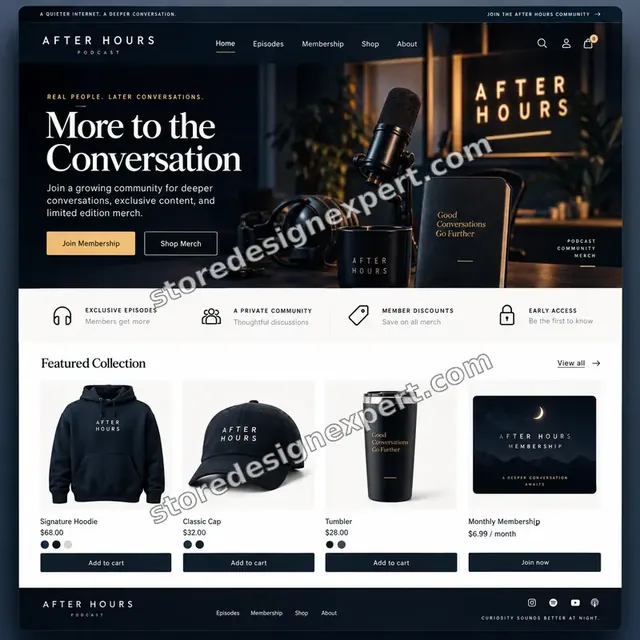
Shopify Stores We Have Built, Ready for Automation
We build the stores and the workflows behind them. These launches show the standard your automation will be built on.
After Hours Podcast creator Shopify Visual
Podcast creator
Clear Botanics Skincare Shopify Visual
Skincare
Monument Home Furniture Shopify Visual
Furniture
Field & Feast Food Shopify Visual
Food
Bright Desk School supplies Shopify Visual
School supplies
Build Bright Digital course Shopify Visual
Digital courseProcess and timeline
Six Stages From Brief to Live Automation
Six stages, in order. Nothing touches live orders until you have seen it work on a copy, and your calculator choices decide how long each stage takes.
- 1
Brief and rules
The brief covers how supplier feed imports works now, who is involved and what goes wrong. Each rule is written in plain words, such as: when a supplier feed updates, then import prices and stock on schedule.
- 2
Access and platform
We ask for the smallest access that works, recommend a platform with its monthly cost and test the connection with a live read.
- 3
Map the data
The data map covers supplier SKU, cost, stock and feed date; formats are checked on both sides and blank values are given a rule.
- 4
Build in a copy
The workflow is built against test data, never your live orders. You see the plan and, where useful, a recorded run.
- 5
Test on real cases
Cases tested: a normal update, a new product and a discontinued product, plus refunds and edits. Every result is compared with Shopify's own figures.
- 6
Go live and hand over
Once you approve, we switch it on, watch the first runs and hand over notes, a diagram and a short recorded tour.
Compare your options
Do It by Hand, Use an App, Build It Yourself or Hire Us for Shopify Supplier Feed Import Automation?
Each route has a place. Read across the rows that matter to you and see which one you would trust with your orders.
| What matters | By hand | Built-in app | No-code platform | Store Design Expert |
|---|---|---|---|---|
| Rules set out and agreed | No | Not often | If you write them | Yes |
| Refunds and edits included in testing | When remembered | Rarely | If you test it | Yes |
| Duplicate protection | Human error | Depends | Possible with effort | Yes |
| A named person hears about failures | No | Sometimes | Only if you add it | Yes |
| You see the cost before we begin | Hours of staff time | Plan fees only | Plan fees and your time | Yes |
| A written and recorded handover | No | No | No | Yes |
| Accounts owned by you | Yes | Yes | Yes | Yes |
| Help after go-live | No | Vendor help desk | Platform help desk | Included window |
Inside every project
How We Protect Your Orders and Customer Data
Automations act on live orders and customer data, so mistakes are costly. These practices come with every package and explain why a fixed fee can still be a careful one.
Nothing sent without approval
Emails, texts and posts that reach customers are approved by you before they are enabled.
Failures raise a flag
A named person receives an alert, with the order and the reason, whenever a run fails.
Secrets kept in a vault
Keys and tokens live in a secure vault, not in notes, spreadsheets or chat.
Build in a copy, never live
Test data comes first. Live orders and feeds are left alone until you sign off.
A written definition of done
The workflow counts as finished only when a normal update, a new product and a discontinued product all pass and are logged.
Counts compared, not assumed
Every catch-up ends with a count against the source, which catches gaps and doubles quickly.
Interactive price calculator
Choose Your Supplier Feed Imports Scope and See the Price
Start with the scope that matches your case, then adjust for platform, volume and the number of connected tools. You see the fixed price before you pay.
Request a custom quote
Workflows that span many systems, need custom code, handle very high volumes or depend on an on-premise system are quoted separately at a fixed price.
Request a QuoteChanged your mind? Choose Single Build, Core Build or Full Build above to return to the instant calculator.
Packages and comparison
Shopify Supplier Feed Import Automation Package Comparison
Here is each package line by line. When you compare our fee with a marketplace listing for Shopify supplier feed import automation, count how many of these checks the cheaper offer actually names.
| What is included | Single Build $790 | Core Build $1,590Recommended | Full Build $2,990 |
|---|---|---|---|
| Trigger for the event: a supplier feed updates | Included | Included | Included |
| Action for the first trigger: import prices and stock on schedule | Included | Included | Included |
| Every step protected from duplicates | Included | Included | Included |
| Failed runs raise an alert | Included | Included | Included |
| Test log and recorded handover | Included | Included | Included |
| A trigger for each: a supplier feed updates, a new product appears in the feed, a product disappears from the feed | Not included | Included | Included |
| Three actions: import prices and stock on schedule; create the product with mapped fields; unpublish or zero the stock | Not included | Included | Included |
| Rules by tag, country and order value | Not included | Included | Included |
| Retries, plus a daily check for silent stops | Not included | Included | Included |
| Edge cases built: refunds, edits and partials | Not included | Not included | Included |
| One-off catch-up of past feeds | Not included | Not included | Included |
| Two weeks of monitoring after go-live | Not included | Not included | Included |
| Runbook with the rules and the fixes | Not included | Not included | Included |
| Typical delivery | 4 to 7 days | 7 to 12 days | 11 to 20 days |
The calculator above is the source of truth for your final price and delivery estimate.
Why Store Design Expert
Why Hire Us to Automate Supplier Feed Imports
Templates cover the happy path. We cover the rest, and we put the result in writing.
Experience since 2015
More than 450 Shopify stores have passed through our hands, so we have met most of the quirks that interfere with automation.
Tested on your real cases
Tests use the cases your store really sees, for example a normal update, a new product and a discontinued product.
Safety designed in
Retries, alerts, unique keys and limited access come as standard in every build.
A direct line to the builder
You talk to the person working on your workflow, and questions about a rule or field get a plain answer.
Notes a colleague can follow
The handover notes say what happens when and why each setting was chosen, so nobody has to guess later.
4.9+ from verified clients
Every review on this page is from a verified Store Design Expert client, which lets you see how projects went first.
What we need to get started
Getting Started: What We Ask For
We need a way into your store, a short brief and a decision-maker. Pick the access route that suits you.
Approve a collaborator request
If the store is live, send us its address and approve our request. Ownership stays with you, our role is limited, and removal takes one click.
Starting from nothing? We build first
We can assemble the store in our own Shopify Partner account, set up the workflow there, then hand the whole store over by ownership transfer. You pick a Shopify plan only at the end.
Or share a staff login
A staff login works if that is easier. We still recommend the collaborator route, since it can be revoked in one click and leaves no password in circulation.
Access to the other tools
Add us to the tools the workflow uses, or have us create accounts under your email. You stay the owner in both cases.
Examples of the work today
Share a few recent cases, or point us to them. Real examples reveal how the process really runs.
A decision-maker
Tell us who approves the rules and the test, and what should happen when two rules disagree.
Your Shopify owner password and card details never reach us. Changes are made in a copy, and we note every setting we touch.
Testimonials
Verified Client Feedback
Read how past projects went before you pick a package.
Verified
Store Design Expert delivered an outstanding website development experience! Their professionalism and attention to detail exceeded my expectations, and their proactive communication kept everything running smoothly. Truly impressed by their deep understanding and dedication.
WG
Warren G.United States
Verified
A pleasure to work with. They did pretty much everything I asked and definitely exceeded my expectations. I will be working with Store Design Expert again soon.
JL
Jerry L.United States
Verified
Superb work! Store Design Expert is incredibly patient, and even when I did not fully understand my own questions, everything was explained again in detail. My vision was implemented perfectly, and the work is worth every cent I spent.
KB
Katrin B.Germany
Verified
Very impressed with the build-out. My store is ready to get started, and I am sure I will reach out for edits down the road, but this is everything I could ask for to get the party started. Thanks again, and I will be in touch for future projects.
DH
Dale H.United States
Verified
Very quick and detailed work! Store Design Expert does exactly what you want, in a very professional manner.
LF
Lena F.Germany
Verified
Store Design Expert did an outstanding job with top-notch professionalism on my website project. Everything was delivered quickly without compromising quality. I could not have asked for better!
JM
Jason M.United States
Verified
The website development work was nothing short of professional, with top-notch quality. Their exceptional level of cooperation made the collaboration seamless and enjoyable. Highly recommend working with Store Design Expert!
JC
Jeremy C.United States
Verified
Super great to work with, and super fair!
RO
Robert O.United States
Verified
The website development work was truly impressive. Their attention to detail and ability to exceed expectations made the project a success. Working with them was a breeze, thanks to quick responsiveness and a willingness to go above and beyond.
KD
Kevin D.United States
FAQ
Supplier Feed Imports Automation FAQs
Straight answers on price, scope, timing and what we need from you.
How much does Shopify supplier feed import automation cost?
Single Build costs $790, Core Build $1590 and Full Build $2990. Platform, volume, the number of connected tools and add-ons change the total, and the calculator shows it before you pay. Most projects land between about $790 and $4190, with delivery from 4 to 20 working days. The same service covers "supplier feed import automation shopify".
How long does supplier feed imports automation take?
Single Build takes 4 to 7 working days, Core Build 7 to 12 and Full Build 11 to 20. The usual variables are how many tools are involved and how quickly you approve the rules and the test. The Sooner and Fastest options shorten the schedule when a date is fixed. People also search for "shopify supplier feed import app"; the work is the same.
How do I import a supplier feed into Shopify?
Use a tool matched to the feed's format and delivery, such as Matrixify for FTP or a URL importer for public feeds. Queries such as "hire shopify supplier feed import developer" describe the same work.
Which tool handles FTP?
Matrixify lists FTP and SFTP imports. Simple CSV does not fetch from FTP. The same service covers "shopify supplier feed import zapier".
Which tool handles XML?
XML-focused apps such as Product XML Import, or a transform step before a CSV tool. If you typed "how to automate supplier feed import on shopify", the answer is the same.
How do I update only stock?
Match on SKU and map only the quantity column. This also answers "shopify supplier feed import workflow".
What if the feed breaks?
Guards stop the import when row counts or prices move too far. This also answers "shopify supplier feed import make.com".
Can I apply my margin?
Yes, price rules with rounding. People also search for "shopify supplier feed import n8n"; this page covers that too.
Can you build it for several suppliers?
Yes. Queries such as "shopify supplier feed import expert" point to this service.
Ready when you are
Book Your Shopify Supplier Feed Import Automation Build
If the steps above sound right, choose a package and answer three questions. Work begins once you check out. This page covers Shopify supplier feed import automation.
- Secure checkout
- Two revision rounds
- Test log and walkthrough included