
Shopify stores designed and launched
Shopify to PostgreSQL, built by specialists
Shopify PostgreSQL Integration, Done for You at a Fixed Price
A Shopify PostgreSQL integration gives you your orders, customers and products in your own database for reporting, finance and custom apps. Shopify has no built-in PostgreSQL export, so a bridge is needed: scheduled polling for reports, webhooks for near real-time, or a two-way sync. We verify webhook signatures, upsert on Shopify's order ID, backfill gaps and test, from $390.
- Schema designed for orders, line items, customers and refunds
- Webhooks verified by signature and written idempotently
- Scheduled backfill that catches missed events
- Test log and a recorded handover
From$390
Delivery3 to 14 working days
Revisions2 rounds
Our track record
Over 450 Stores Built Since 2015. Here Is What That Means for Your PostgreSQL Link.
A decade spent in hundreds of Shopify stores pays off in small decisions: which id to use as the key, when to retry, which field wins a conflict. Those decisions make a database or data warehouse integration calm and trouble-free.
Average rating from verified clients
Building Shopify stores since
Secure checkout
Pay through a protected checkout and keep a full order record.
Two revision rounds
Included in every package, so the result matches what you pictured.
Backup before changes
We work on a duplicate of your theme, never on your live store.
Who this is for
Six Situations Where Shopify PostgreSQL Integration Pays Off
Your own database is only useful if it matches Shopify. These are the cases we build for.
You are a good fit if
- Shopify is your store platform
- You can give us limited access to PostgreSQL
- You want a clear scope and price
- Someone can confirm the test results
Teams building reports and dashboards
Scheduled sync is the simplest route when about 15-minute-old data is acceptable.
Teams needing near real-time
Webhooks on order create, update and cancel write each change as it happens.
Teams needing two-way changes
A sync engine with change data capture can send edits back to Shopify.
Teams with big history
Some lightweight tools struggle with large historical loads. We chunk the backfill.
Teams wanting full control
A custom ETL against the REST API with a private app.
Teams comparing tools
Coupler.io, Fivetran, Hevo and Stacksync price differently. We compare.
Problems solved
Shopify PostgreSQL Integration: Six Faults We Fix First
Database syncs fail on duplicates and gaps. These are the six faults we fix.
The problem
Duplicate rows
The outcome
Retried webhooks insert twice. We upsert on the order ID.
The problem
Unverified webhooks
The outcome
Anyone could post. We verify the signature on the raw body.
The problem
Missed events
The outcome
A webhook is lost. We run a periodic backfill.
The problem
Messy schema
The outcome
Line items and refunds are flattened badly. We design tables.
The problem
Slow historical load
The outcome
The first load stalls. We chunk it.
The problem
No handover
The outcome
Nobody knows the schema. We document it.
What we can do
What Our Shopify PostgreSQL integration Work Includes, Piece by Piece
How we connect PostgreSQL and Shopify, in order.
Schema
Tables and keys.
Receiver
Verify and upsert.
Backfill
History and gap checks.
Connection
Tool or custom ETL.
Tests
Create, update, cancel, refund.
Handover
Notes and recording.
What is included
What Is Inside Your PostgreSQL Integration
Deliverables fall into six groups. The package table below shows how much of each group a given price covers, so the gap between packages is easy to judge.
Connection
- Roles and permissions reviewed with you
- Shopify access limited to what the flow needs
- Secrets kept in a vault, not in a note
- Regular connection health check
Triggers
- Rules by tag, country or order value
- Trigger built for when a refund is issued
- Event order verified
- Flow starts when an order is created
Mapping
- Who wins each field, in writing
- Total price covered, blanks included
- Formats agreed for created at and customer id
- Mapping for order id
Safety
- Alerting on failed runs
- Safe retries
- Rate limits respected
- A daily check catches silent stops
Testing
- Test on an order edited after payment
- Refund and edit cases checked
- Test on a customer merge
- Tested with a late webhook
Handover
- Diagram of what moves where
- Help with questions after go-live
- Everything in your name
- Screen-recorded tour of the flow
Your part is access, a short brief and a ruling on conflicts. Ours is the build, the test and the handover.
What we connect and check
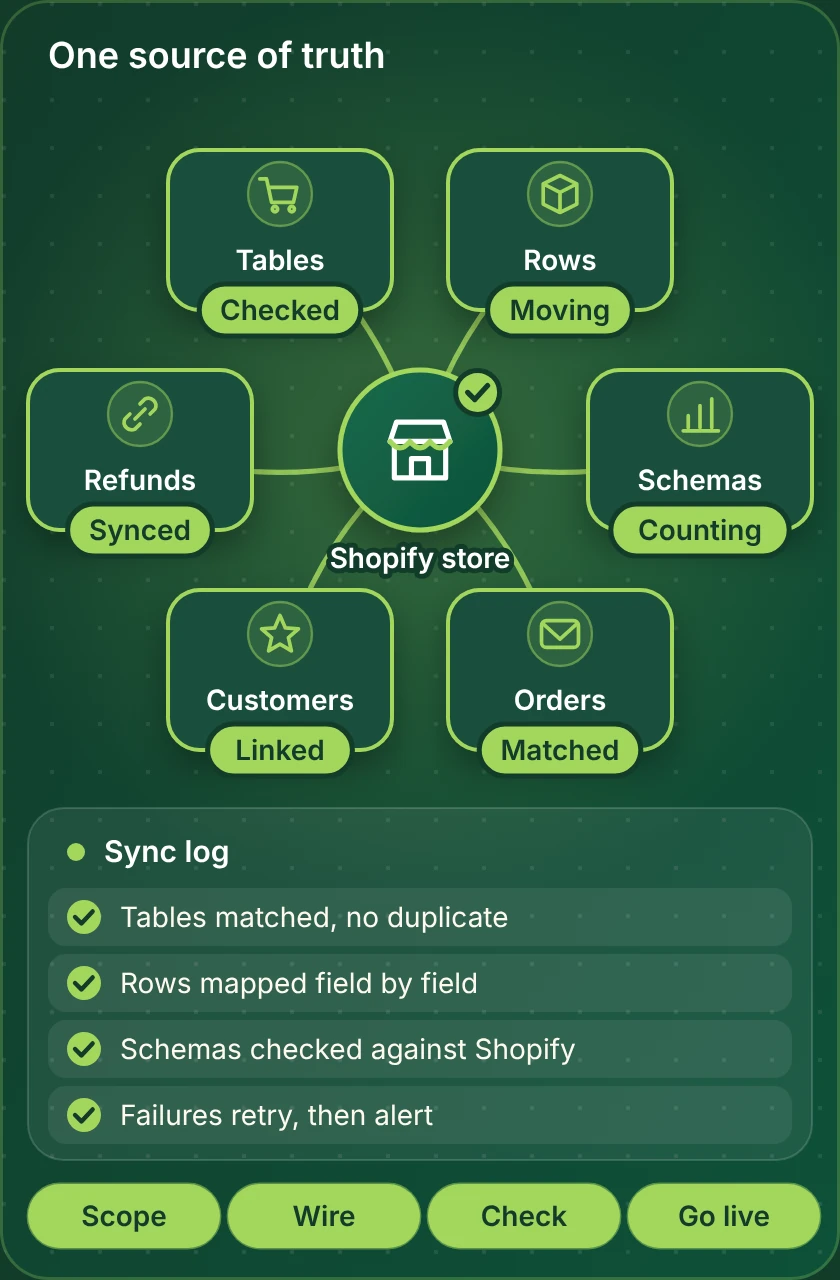
How Shopify PostgreSQL Integration Moves Data Between Shopify and PostgreSQL
Picture the build as a short chain: event, check, write, log. Each link is tested on its own and again as a whole, with real orders, before we ask you to approve anything.
Portfolio
Shopify Stores We Have Built That Are Ready for PostgreSQL
A clean connection works best on a tidy store. Scroll through stores we have designed and launched, and picture each one with PostgreSQL wired in behind it.

Verdure Lab Skincare Shopify Visual
Skincare
Still House Home decor Shopify Visual
Home decor
Amora Fine Jewelry Shopify Visual
Jewelry
First Light Coffee Shopify Visual
Coffee
Specialty Coffee Subscription Shopify Store
Specialty coffee
Fine Arc Jewelry Shopify Visual
JewelryProcess and timeline
Six Stages From Brief to Live PostgreSQL Sync
We follow the same six steps on every build, which is why the price can be fixed.
- 1
Brief and scope
First we find out what you sell, how your team uses PostgreSQL and which events count. A quick look at your orders and tables tells us where to begin and what to avoid.
- 2
Access and connection
We ask for the smallest access that works, via a database user with write rights on one schema. A live read confirms it before we build on top of it.
- 3
Map and rule
Order id, created at, customer id and total price are matched across both tools, and we record who wins each conflict and how blanks are treated.
- 4
Build in a copy
Nothing is built on live records. The flow runs on test data first, and you see the plan, plus a recording if useful.
- 5
Test on real cases
Cases tested: a late webhook, a customer merge and an order edited after payment, plus refunds and edits. Every result is compared with Shopify's own figures.
- 6
Go live and hand over
After your approval we turn the flow on, follow the first live runs, then hand over notes, a diagram and a short recorded tour.
Compare your options
Four Ways to Connect PostgreSQL and Shopify, Compared
There are four common ways to connect Shopify and PostgreSQL. This table compares the checks that decide whether the data stays right, whether failures are noticed and whether you can hand it over.
| What matters | PostgreSQL app or DIY | Automation platform | Freelance gig | Store Design Expert |
|---|---|---|---|---|
| Every field mapped by design | Basic defaults | If you build it | Depends on the seller | Yes |
| Unique key stops duplicate records | Rarely handled | If you add it | Rarely | Yes |
| Failures alert a named person | No | Optional extra | Rarely | Yes |
| Tested on refunds and edits | Rarely | When you test | Depends | Yes |
| Fixed price up front | Subscription only | Plan fees and your time | Yes | Yes |
| Notes and a recorded walkthrough | No | No | Rarely | Yes |
| Accounts stay in your name | Yes | Yes | Depends | Yes |
| Questions answered after launch | Vendor help desk | Platform help desk | Depends | Included for a period |
Inside every project
Six Safeguards Built Into Every PostgreSQL Integration
None of these costs extra. They are simply how we work.
Failures raise a flag
A failed run alerts a named person with the order and the reason. Silence never means success.
A written definition of done
Done means the flow copes with a late webhook, a customer merge and an order edited after payment, and the results are written in the log.
Nothing sent without approval
Anything that emails, texts or posts to a customer is reviewed with you before it is switched on.
Narrow access, in your name
The smallest workable access, set up through a database user with write rights on one schema, with all accounts in your name.
Build in a copy, never live
Everything is built and tested on test data, so your live orders and tables stay untouched until you approve.
Plain scope, two revision rounds
You know the cost up front. Two revision rounds cover changes within scope, which keeps tweaks from becoming extra invoices.
Interactive price calculator
Build Your PostgreSQL Integration Package
Choose a package, tell us about your order volume, data direction and existing PostgreSQL data, then pick a speed. The fixed price and delivery window update with each selection.
Request a custom quote
Projects beyond these packages, such as bespoke objects, heavy history loads, multi-store designs or a custom API build, are scoped and quoted at a fixed price after a short call.
Request a QuoteChanged your mind? Choose Single Workflow, Core Workflows or Full Integration above to return to the instant calculator.
Packages and comparison
PostgreSQL Integration Package Comparison
Here is each package line by line. When you compare our fee with a marketplace listing for Shopify PostgreSQL integration, count how many of these checks the cheaper offer actually names.
| What is included | Single Workflow $390 | Core Workflows $790Recommended | Full Integration $1,490 |
|---|---|---|---|
| PostgreSQL linked with a database user with write rights on one schema | Included | Included | Included |
| First trigger built: an order is created | Included | Included | Included |
| Mapping for order id, created at and customer id | Included | Included | Included |
| Duplicate protection on every write | Included | Included | Included |
| Test log plus a recorded walkthrough | Included | Included | Included |
| Events handled: an order is created; a customer changes; a refund is issued | Not included | Included | Included |
| Total price plus custom fields matched | Not included | Included | Included |
| Tag, country and value filters | Not included | Included | Included |
| Retries and failure alerts | Not included | Included | Included |
| Both-way sync with a winner for each field | Not included | Not included | Included |
| One-off history load of past tables | Not included | Not included | Included |
| Two weeks of monitoring after go-live | Not included | Not included | Included |
| Team runbook in plain English | Not included | Not included | Included |
| Typical delivery | 3 to 5 days | 5 to 9 days | 8 to 14 days |
The calculator above is the source of truth for your final price and delivery estimate.
Why Store Design Expert
Why Owners Choose Our Shopify PostgreSQL Integration Over Doing It Alone
You are paying for judgement and for a result you can inspect, not for hours.
A direct line to the builder
Ask the person who built it. Questions about triggers or fields get a direct reply.
Safety designed in
Retries, alerts, unique keys and narrow access are in every build, not offered as extras.
Experience since 2015
More than 450 Shopify stores have passed through our hands, so we have met most of the quirks that interfere with integrations.
We live inside Shopify
We work with Shopify orders, refunds, edits and metafields daily. That depth is separate from knowing PostgreSQL's interface.
Tested on your real cases
We check against your own cases, like a late webhook, a customer merge and an order edited after payment.
A price you can plan around
Every package and option shows its price and extra days in the calculator. Any PostgreSQL plan fees are billed to you by PostgreSQL, so check its current pricing page.
What we need to get started
Getting Started: What We Ask For
The list is short. Most owners have everything ready in a day.
Approve a collaborator request
Already selling? Send the store address and accept the request we raise. You stay the owner, we see only what the role permits, and you can remove us at any time.
Starting from nothing? We build first
We can start in our own Partner account, set up the store and the PostgreSQL link, then transfer ownership to you. A Shopify plan is chosen at the end.
Or share a staff login
If it is simpler, a staff login will do. We prefer the collaborator route because it is revocable in one click and no password changes hands.
Your PostgreSQL access
Either create the PostgreSQL account yourself and add us, or we open it with your email. You remain the owner, and we work through a database user with write rights on one schema.
Sample records
Send two or three typical records from each side, or tell us where to find them. Real examples show us how your data is actually shaped.
A decision-maker
Tell us who approves the plan and the test, and which rule should win when PostgreSQL and Shopify disagree.
Your Shopify owner password and card details never reach us. Changes are made in a copy, and we note every setting we touch.
Testimonials
Verified Client Feedback
Read how past projects went before you pick a package.
Verified
Store Design Expert is the best. The work is very professional, they pay close attention to detail and, more importantly, they listen. Their level of cooperation is second to none, and everything was delivered in a very timely manner. I will keep them in mind for future projects.
BN
Barbara N.United States
Verified
The experience was tailored to my brand and specifications to the letter. I love the result.
EP
Eric P.United States
Verified
They definitely get the job done. Very patient and understanding throughout the whole project.
BS
Brian S.United States
Verified
Thank you so much to Store Design Expert and the team. My site looks far more appealing to customers, and I will happily recommend your services to other new small businesses.
JS
Jennifer S.United States
Verified
Very patient, informative and transparent, and they did exactly what they said they would do. Thanks for all the help!
RO
Raymond O.United States
Verified
Store Design Expert is the only one I use for all things WordPress. They have a high level of understanding, deliver quality work and are easy to deal with.
SC
Scott C.United States
Verified
A pleasure to work with. They did pretty much everything I asked and definitely exceeded my expectations. I will be working with Store Design Expert again soon.
JL
Jerry L.United States
Verified
Superb work! Store Design Expert is incredibly patient, and even when I did not fully understand my own questions, everything was explained again in detail. My vision was implemented perfectly, and the work is worth every cent I spent.
KB
Katrin B.Germany
Verified
Very impressed with the build-out. My store is ready to get started, and I am sure I will reach out for edits down the road, but this is everything I could ask for to get the party started. Thanks again, and I will be in touch for future projects.
DH
Dale H.United States
FAQ
PostgreSQL Integration FAQs
Straight answers on price, scope, timing and what we need from you.
How much does Shopify PostgreSQL integration cost?
Single Workflow costs $390, Core Workflows $790 and Full Integration $1490. Order volume, data direction, existing PostgreSQL data and add-ons change the total, and the calculator shows it before you pay. Most projects land between about $390 and $2090, with delivery from 3 to 14 working days.
How long does the PostgreSQL integration take?
Single Workflow takes 3 to 5 working days, Core Workflows 5 to 9 and Full Integration 8 to 14. The usual variables are how much history you want loaded and how quickly you approve the test results. The Sooner and Fastest options shorten the schedule when a launch date is fixed.
Does Shopify export to PostgreSQL?
Not built in; a bridge is needed.
What is the simplest route?
Scheduled sync for reporting. Another way to phrase it: "shopify to postgresql sync"; the work is the same.
How do I get near real-time?
Webhooks on order events. If you typed "postgresql shopify zapier", you are in the right place.
Can changes go back to Shopify?
A two-way sync engine can do it. The same job is behind "postgresql shopify make.com".
How do you avoid duplicates?
Upsert on Shopify's order ID. The same job is behind "postgresql shopify n8n".
How do you catch missed events?
A periodic backfill.
Can you build it?
Yes.
Ready when you are
Book Your Shopify PostgreSQL Integration Build
Select a package, watch the fixed price settle and order a Shopify PostgreSQL integration build from a team that has launched 450+ Shopify stores. The connection is tested on real cases before you are asked to approve anything.
- Secure checkout
- Two revision rounds
- Test log and walkthrough included