
Shopify stores designed and launched
product sync between stores, automated for Shopify
Multi Store Sync Shopify, That Runs Without Anyone Remembering
Multi store sync Shopify work keeps two or more stores in step: products, prices and images copied from a main store, stock shared so one sale reduces both, and rules for what each store may change. Shopify does not sync separate stores natively, and apps differ: some work per feed and location, others match on SKU or barcode. We choose between Markets, an app or a custom build and test it with real orders, from $290.
- Decision made first: one store with Markets, or separate stores with sync
- Products, prices and images synced from a main store, by SKU or barcode
- Stock shared across stores with conflict rules
- Test log and a recorded handover
From$490
Delivery3 to 14 working days
Revisions2 rounds
Our track record
Built on 450+ Shopify Stores. Your Product Sync Between Stores Project Is Scoped and Priced Before We Start.
No hourly meter and no mystery. Choose a package, adjust the options and see the price and timing before you pay.
Average rating from verified clients
Building Shopify stores since
Secure checkout
Pay through a protected checkout and keep a full order record.
Two revision rounds
Included in every package, so the result matches what you pictured.
Backup before changes
We work on a duplicate of your theme, never on your live store.
Who this is for
Who Hires Us for Multi Store Sync Shopify
Multi-store setups multiply admin. These are the cases we build for.
You are a good fit if
- Shopify is your store platform
- You can give us limited access to your tools
- You want a clear scope and price
- Someone can confirm the test results
Brands with regional stores
Copy products from the main store and keep local price overrides.
Retailers sharing stock
A sale in one store reduces stock in the others, matched by SKU.
Owners whose SKUs clash
Two products with the same SKU need a source-of-truth rule.
Owners deciding on cost
Markets in one store can be cheaper than two stores plus sync. We compare.
Teams with a main and dependent stores
The main store edits; dependents follow.
Teams building their own
A custom API build monitors changes and updates the others.
Problems solved
Why multi store sync Shopify Projects Go Wrong, and How We Prevent It
Multi-store sync fails on identity and conflict. These are the six faults we fix.
The problem
SKU mismatch
The outcome
Match fails. We clean SKUs.
The problem
Stock overwritten
The outcome
Two stores write at once. We choose a source.
The problem
Local changes overwritten
The outcome
We protect local fields.
The problem
Paid plan surprise
The outcome
Destination store needs a plan. We check.
The problem
One location per feed
The outcome
Multiple locations need multiple feeds.
The problem
No owner
The outcome
We assign.
What we can do
Multi Store Sync Shopify: What We Build and Configure
How we build multi-store sync, in order.
Decision
Markets or multiple stores.
Matching
SKU or barcode identity.
Conflict rules
Who wins each field.
Sync setup
App or custom.
Tests
Orders in each store.
Handover
Notes and recording.
What is included
What Is Inside Your Product Sync Between Stores Automation
Here is the full list, grouped by job. Entry packages cover the first items in each group; bigger ones go further.
Design
- A list of triggers and conditions
- Rules set out and signed off
- Fields and formats settled
- Platform chosen with a cost estimate
Triggers
- Trigger built for when stock changes in either store
- Trigger built for when a product is created in the main store
- Filters set by tag, country or value
- Late and early events handled
Actions
- Price and inventory handled, including blanks
- Step built to create it in the other store
- The workflow will keep both stock levels honest
- Customer messages approved first
Safety
- Rate limits respected
- Opt-outs and consent respected
- Idempotent steps throughout
- Daily check for silent stops
Testing
- Tests recorded in a log
- Test on a price change
- Scenario tested: a stock change
- Test on a new product
Handover
- Two revision rounds included
- Flow diagram included
- Written notes on every rule
- Everything in your name
Your part is access, a brief and a decision on the rules. Ours is the build, the test and the handover.
What we build and check
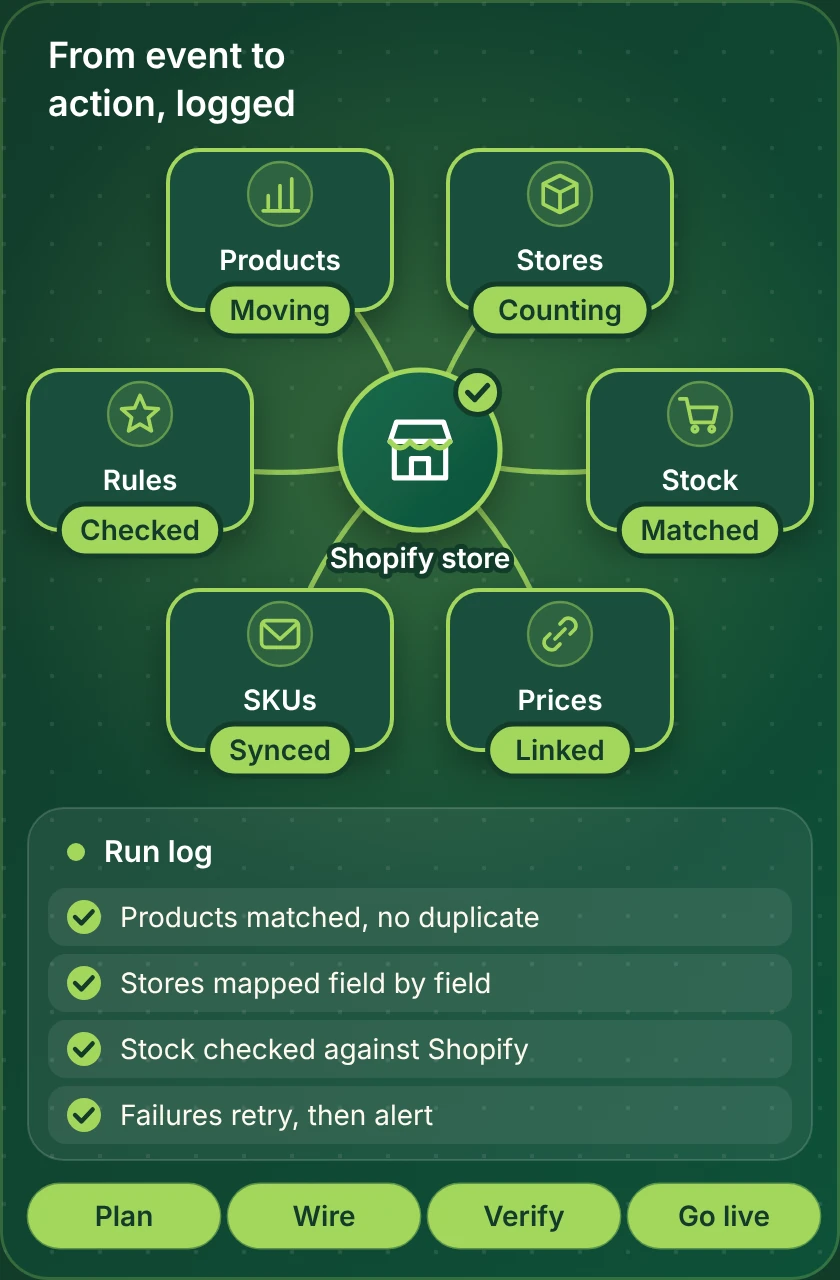
What Happens When a product is created in the main store
All automations follow the same path. An event arrives, the rules decide what applies, the action runs and the result is logged where your merchandising team can see it. This map shows the pieces we build and test before handover.
Portfolio
Stores We Designed That Run Smoothly Behind the Scenes
A clean automation works best on a tidy store. Browse stores we have designed and launched, and picture each with product sync between stores running behind it.

Far North Outdoor Shopify Visual
Outdoor
Studio Meridian Home goods Shopify Visual
Home goods
Fitness Recovery Dropshipping Store
Fitness recovery
Luxury Fashion Editorial Shopify Store
Luxury fashion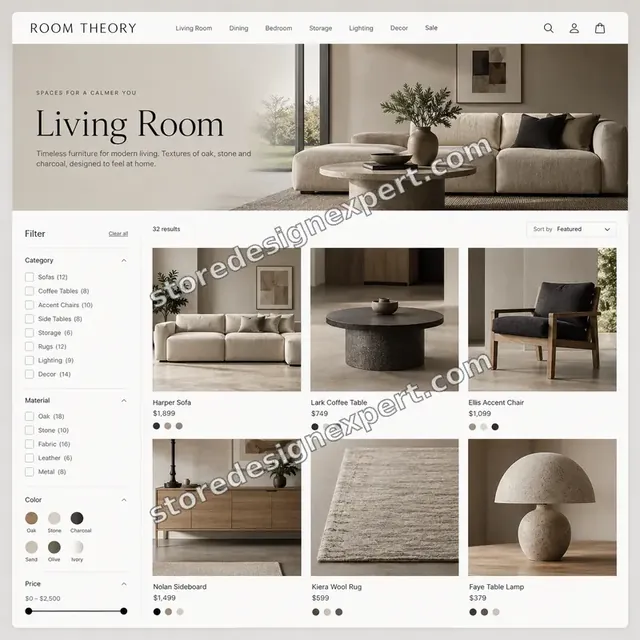
Room Theory Furniture Shopify Visual
Furniture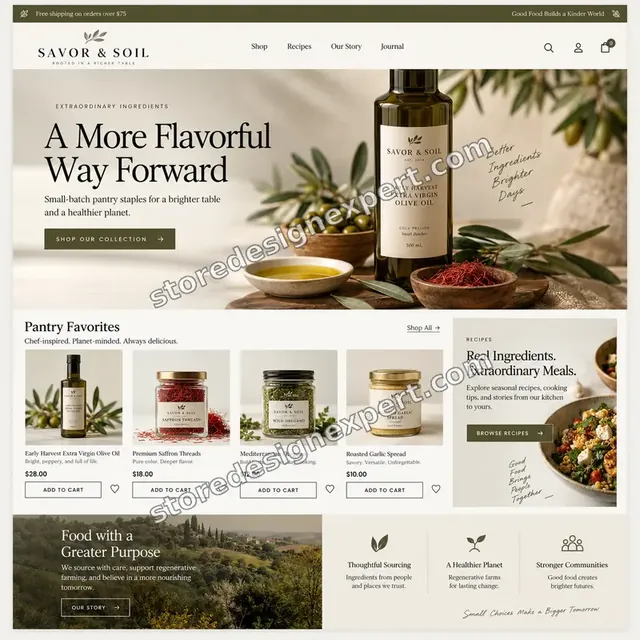
Savor & Soil Food Shopify Visual
FoodProcess and timeline
How We Build Your Product Sync Between Stores Automation, Step by Step
Six stages, in order. Nothing touches live orders until you have seen it work on a copy, and your calculator choices decide how long each stage takes.
- 1
Brief and rules
First we learn how product sync between stores runs today, who does what and where it breaks. Then we write every rule in plain words: when a product is created in the main store, then create it in the other store.
- 2
Access and platform
We ask for the smallest access that works, recommend a platform with its monthly cost and test the connection with a live read.
- 3
Map the data
We list SKU, handle, price and inventory, check formats on both sides and agree what blanks should do.
- 4
Build in a copy
Nothing is built on live orders. The workflow runs on test data first, and you see the plan, plus a recording if useful.
- 5
Test on real cases
Cases tested: a new product, a price change and a stock change, plus refunds and edits. Every result is compared with Shopify's own figures.
- 6
Go live and hand over
After your approval we turn it on, follow the first live runs, then hand over notes, a diagram and a short recorded tour.
Compare your options
Do It by Hand, Use an App, Build It Yourself or Hire Us for Multi Store Sync Shopify?
There are four common ways to handle product sync between stores. This table compares the checks that decide whether the work stays right, whether failures are noticed and whether you can hand it on.
| What matters | By hand | Built-in app | No-code platform | Store Design Expert |
|---|---|---|---|---|
| Rules written down and agreed | No | Seldom | If you document them | Yes |
| Awkward cases checked | When remembered | Not usually | If you test | Yes |
| Duplicate protection | Human error | Hit and miss | If you add it | Yes |
| Alerts when something breaks | No | Occasionally | If you add it | Yes |
| You see the cost before we begin | Your team's time | Subscription only | Plan fees plus your time | Yes |
| Documentation and video handover | No | No | No | Yes |
| Accounts stay in your name | Yes | Yes | Yes | Yes |
| Help after go-live | No | Vendor help desk | Help desk of the platform | Included window |
Inside every project
How We Protect Your Orders and Customer Data
Automations act on live orders and customer data, so mistakes are costly. These practices come with every package and explain why a fixed fee can still be a careful one.
Plain scope, two revision rounds
You see the price before paying. Changes within scope go through two structured rounds, so a tweak never becomes an hourly invoice.
Build in a copy, never live
Test data comes first. Live orders and products are left alone until you sign off.
Failures raise a flag
Failed runs notify a named person with the order and the cause, so silence cannot hide a problem.
A written definition of done
Done means the workflow copes with a new product, a price change and a stock change, and the results are written in the log.
Secrets kept in a vault
A secure vault holds every key and token; none appear in notes or chat.
Narrow access, in your name
Access is as narrow as possible and every account remains yours.
Interactive price calculator
Choose Your Product Sync Between Stores Scope and See the Price
Start with the scope that matches your case, then adjust for platform, volume and the number of connected tools. You see the fixed price before you pay.
Request a custom quote
Workflows that span many systems, need custom code, handle very high volumes or depend on an on-premise system are quoted separately at a fixed price.
Request a QuoteChanged your mind? Choose Single Automation, Core Automations or Full Automation Set above to return to the instant calculator.
Packages and comparison
Multi Store Sync Shopify Package Comparison
Here is each package line by line. When you compare our fee with a marketplace listing for multi store sync Shopify, count how many of these checks the cheaper offer actually names.
| What is included | Single Automation $490 | Core Automations $990Recommended | Full Automation Set $1,790 |
|---|---|---|---|
| One trigger built: when a product is created in the main store | Included | Included | Included |
| An action to create it in the other store | Included | Included | Included |
| Every step protected from duplicates | Included | Included | Included |
| A named person hears about failures | Included | Included | Included |
| Written test log and video handover | Included | Included | Included |
| Three triggers: a product is created in the main store; a price changes; stock changes in either store | Not included | Included | Included |
| Steps to create it in the other store, update the matching product and keep both stock levels honest | Not included | Included | Included |
| Tag, country and value filters | Not included | Included | Included |
| Automatic retries with a daily check | Not included | Included | Included |
| Edge cases covered: refunds, edits, partials | Not included | Not included | Included |
| Past products caught up in one pass | Not included | Not included | Included |
| Two weeks of monitoring after go-live | Not included | Not included | Included |
| Team runbook in plain English | Not included | Not included | Included |
| Typical delivery | 3 to 6 days | 5 to 9 days | 8 to 14 days |
The calculator above is the source of truth for your final price and delivery estimate.
Why Store Design Expert
What You Get From Us That a Template Does Not
Most of this job is clicking, and you could do it. People hire us because the unglamorous parts, ids, timing and edge cases, decide whether automation helps or hurts.
Experience since 2015
Over 450 Shopify stores since 2015 mean we have seen most of the odd cases that break automations.
4.9+ from verified clients
Reviews on this page come from verified Store Design Expert clients, so you can see how projects went before paying.
We live inside Shopify
Orders, refunds, edits and metafields are what we handle every day, which is a different skill from knowing a tool's menus.
Notes a colleague can follow
We document what happens when and which settings we picked, so the next developer starts informed.
Tested on your real cases
We check against your own cases, like a new product, a price change and a stock change.
A direct line to the builder
Ask the person who built it. Questions about rules or fields get a direct reply.
What we need to get started
What to Prepare Before We Start Your Product Sync Between Stores Automation
We need a way into your store, a short brief and a decision-maker. Pick the access route that suits you.
Approve a collaborator request
If the store is live, send us its address and approve our request. Ownership stays with you, our role is limited, and removal takes one click.
Starting from nothing? We build first
We can assemble the store in our own Shopify Partner account, set up the workflow there, then hand the whole store over by ownership transfer. You pick a Shopify plan only at the end.
Or share a staff login
If it is simpler, a staff login will do. We prefer the collaborator route because it is revocable in one click and no password changes hands.
Access to the other tools
Add us to the tools the workflow uses, or have us create accounts under your email. You stay the owner in both cases.
Examples of the work today
Share a few recent cases, or point us to them. Real examples reveal how the process really runs.
A decision-maker
We need one person to approve the rules and the test, plus a ruling for when two rules clash.
Your Shopify owner password and card details never reach us. Changes are made in a copy, and we note every setting we touch.
Testimonials
What Store Owners Say After Working With Us
Read how past projects went before you pick a package.
Verified
Store Design Expert is the best. The work is very professional, they pay close attention to detail and, more importantly, they listen. Their level of cooperation is second to none, and everything was delivered in a very timely manner. I will keep them in mind for future projects.
BN
Barbara N.United States
Verified
They definitely get the job done. Very patient and understanding throughout the whole project.
BS
Brian S.United States
Verified
Thank you so much to Store Design Expert and the team. My site looks far more appealing to customers, and I will happily recommend your services to other new small businesses.
JS
Jennifer S.United States
Verified
Very patient, informative and transparent, and they did exactly what they said they would do. Thanks for all the help!
RO
Raymond O.United States
Verified
Store Design Expert is the only one I use for all things WordPress. They have a high level of understanding, deliver quality work and are easy to deal with.
SC
Scott C.United States
Verified
A pleasure to work with. They did pretty much everything I asked and definitely exceeded my expectations. I will be working with Store Design Expert again soon.
JL
Jerry L.United States
Verified
Superb work! Store Design Expert is incredibly patient, and even when I did not fully understand my own questions, everything was explained again in detail. My vision was implemented perfectly, and the work is worth every cent I spent.
KB
Katrin B.Germany
Verified
Very impressed with the build-out. My store is ready to get started, and I am sure I will reach out for edits down the road, but this is everything I could ask for to get the party started. Thanks again, and I will be in touch for future projects.
DH
Dale H.United States
Verified
Very quick and detailed work! Store Design Expert does exactly what you want, in a very professional manner.
LF
Lena F.Germany
FAQ
Product Sync Between Stores Automation FAQs
Straight answers on price, scope, timing and what we need from you.
How much does multi store sync Shopify cost?
Single Automation costs $490, Core Automations $990 and Full Automation Set $1790. Platform, volume, the number of connected tools and add-ons change the total, and the calculator shows it before you pay. Most projects land between about $490 and $2510, with delivery from 3 to 14 working days. This also answers "shopify multi store sync shopify zapier".
How long does product sync between stores automation take?
Single Automation takes 3 to 6 working days, Core Automations 5 to 9 and Full Automation Set 8 to 14. The usual variables are how many tools are involved and how quickly you approve the rules and the test. The Sooner and Fastest options shorten the schedule when a date is fixed. Searches like "shopify multi store sync shopify workflow" point to this service.
Does Shopify sync stores natively?
No. Multi-location works within one store; separate stores need an app or custom build. The same job is behind "how to automate multi store sync shopify on shopify".
Should I use Markets instead of two stores?
Markets covers regions within one store. We compare it with separate stores for your needs. The same job is behind "shopify sync products between stores". Related searches such as "shopify multi store sync shopify make.com", the answer is the same.
How do sync apps match products?
Syncio matches on SKU or barcode; Salestio matches on SKU. Queries such as "shopify multi store sync power" point to this service. If you came here from "shopify multi store sync shopify n8n", this is the page for it.
Can multiple locations sync?
Stock Sync notes each feed updates one location. Another way to phrase it: "shopify multi store inventory sync"; this page covers that too. Searches like "shopify multi store sync shopify expert" lead to the same build.
What if two products share a SKU?
Syncing needs a source of truth rule. If you typed "syncio multi store sync shopify", this is the page for it. Searches like "hire shopify multi store sync shopify developer" point to this service.
Can local prices stay different?
Yes, with protected fields. If you came here from "multi store sync app shopify", the answer is the same. Queries such as "shopify multi store sync shopify app" lead to the same build.
Can you build a custom sync?
Yes. People also search for "shopify sync products between stores zapier"; the work is the same.
Ready when you are
Ready to Automate Product Sync Between Stores?
You have seen the process, the safeguards and the price. The next step is to pick a package and tell us how your store works. This page covers multi store sync Shopify.
- Secure checkout
- Two revision rounds
- Test log and walkthrough included