
Shopify stores designed and launched
Shopify order tagging by specialists
Shopify Auto Tag Orders Automation, Set Up Once, Trusted Every Day
Shopify auto tag orders automation adds the right tags to every order the moment it is placed, by country, channel, discount, product type or value, so your team can filter, route and report without opening each order. Shopify allows up to 250 tags per order and 40 characters for each order tag, so the scheme has to be planned. We design the rules, build and test them on real orders and document the result, from $290.
- Tag scheme designed within Shopify's limits: 250 tags per order, 40 characters per order tag
- Rules for country, channel, discount code, product type and order value
- Past orders tagged once in a controlled backfill
- Test log and a recorded handover
From$290
Delivery3 to 12 working days
Revisions2 rounds
Our track record
450+ Shopify Stores Launched Since 2015. Your Order Tagging Gets the Same Care.
Automations rarely fail on the easy case. After a decade inside Shopify stores, we know which odd orders, edits and refunds break a workflow, and we plan for them from the first rule.
Average rating from verified clients
Building Shopify stores since
Secure checkout
Pay through a protected checkout and keep a full order record.
Two revision rounds
Included in every package, so the result matches what you pictured.
Backup before changes
We work on a duplicate of your theme, never on your live store.
Who this is for
Shopify Auto Tag Orders Automation: Who It Helps Most
Order tags only help if they are consistent. These are the cases we build for.
You are a good fit if
- You sell on Shopify today or soon
- Someone can approve the rules and the test
- You prefer a quote to an hourly meter
- You will own every account involved
Owners tagging by hand
Someone spends minutes a day tagging orders and still misses some. A rule does it every time.
Teams routing by tag
Fulfilment, support and finance filter by tags. We keep the names consistent.
International sellers
Country and region tags support duties, couriers and reporting.
Teams analysing discounts
A tag per discount code or campaign makes results easy to filter.
Owners whose tags broke a workflow
A tag longer than 40 characters or with an invalid character can fail silently. We validate them.
Stores with years of untagged orders
Flow only handles new events, so history needs a one-off backfill. We run it in batches.
Problems solved
Why Shopify auto tag orders automation Projects Go Wrong, and How We Prevent It
Tagging rules fail on details. These are the six faults we fix.
The problem
Tags that are too long or invalid
The outcome
Order tags are limited to 40 characters and to letters, numbers and hyphens. We build tags to fit.
The problem
Case duplicates
The outcome
Shopify treats VIP and vip as the same tag, but your reports may not. We pick one style.
The problem
Tag sprawl
The outcome
Hundreds of one-off tags are useless. We define a short list.
The problem
Tags added too early
The outcome
An unpaid order is tagged as paid. We use the right trigger.
The problem
No history
The outcome
New rules do not touch old orders. We backfill.
The problem
Nobody knows what tags mean
The outcome
We write a tag dictionary.
What we can do
Six Parts of a Reliable Order Tagging Workflow
How we build order tagging, in order.
Tag scheme
Names, meanings and limits written down.
Rules
Conditions on country, channel, discount, product and value.
Validation
Length and characters checked before a tag is written.
Backfill
Past orders tagged in controlled batches.
Alerts
Failed tag actions reported.
Handover
Dictionary, test log and recording.
What is included
What Is Inside Your Order Tagging Automation
Six groups, four checks each. Compare them with any quote you have and see which ones it names.
Design
- Rules written in plain words and approved
- Every trigger and condition named
- The right platform, with a monthly estimate
- Edge cases agreed: refunds, edits, partials
Triggers
- Trigger built for when an order is created
- Tag, country and value filters
- Event order verified
- Every trigger proven separately
Actions
- Discount code and line items mapped, blanks handled
- Action built: add a handling tag for the warehouse
- Messages reviewed before they go live
- Action built: add a paid tag and remove the pending one
Safety
- Rate limits respected
- Daily check for silent stops
- Failure alerts to a named person
- Every step keyed to the Shopify id
Testing
- Refunds and edits tested
- Tested with an order with mixed items
- Test log handed over
- Tested with a discounted order
Handover
- Questions answered after launch
- Every rule explained in writing
- Recorded walkthrough of the workflow
- Two revision rounds included
Your part is access, a brief and a decision on the rules. Ours is the build, the test and the handover.
What we build and check
How We Wire Up Order Tagging for Your Store
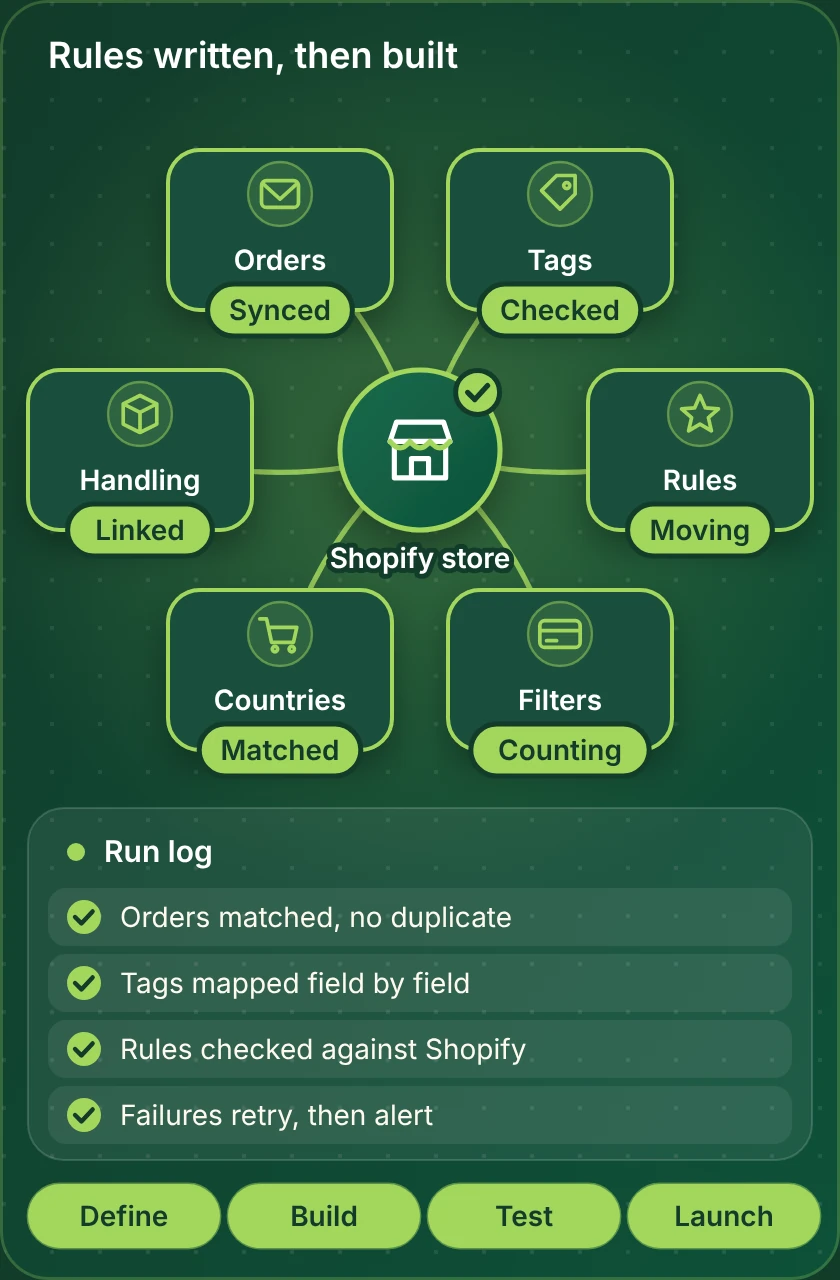
Picture the build as a short chain: event, rule, action, log. Each link is tested on its own and again as a whole, on real orders, before we ask you to approve anything.
Portfolio
Shopify Stores We Have Built, Ready for Automation
Automations sit behind the storefront, so here is the storefront we build. Imagine each store below with order tagging working quietly in the background.
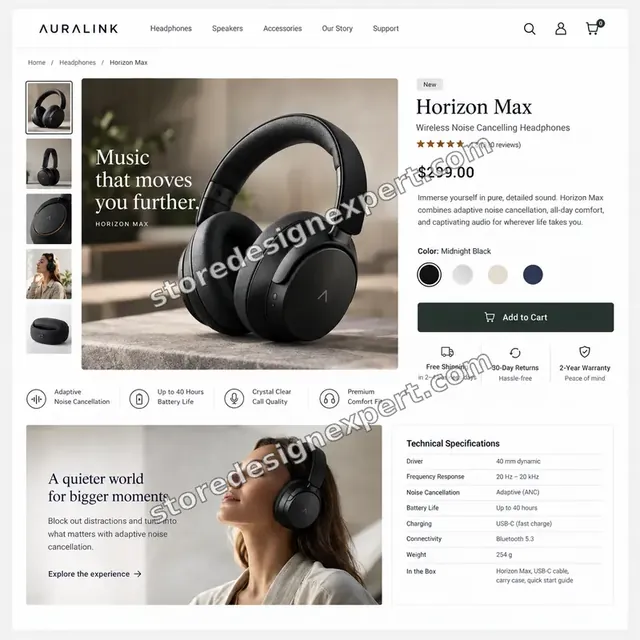
Auralink Audio Shopify Visual
Audio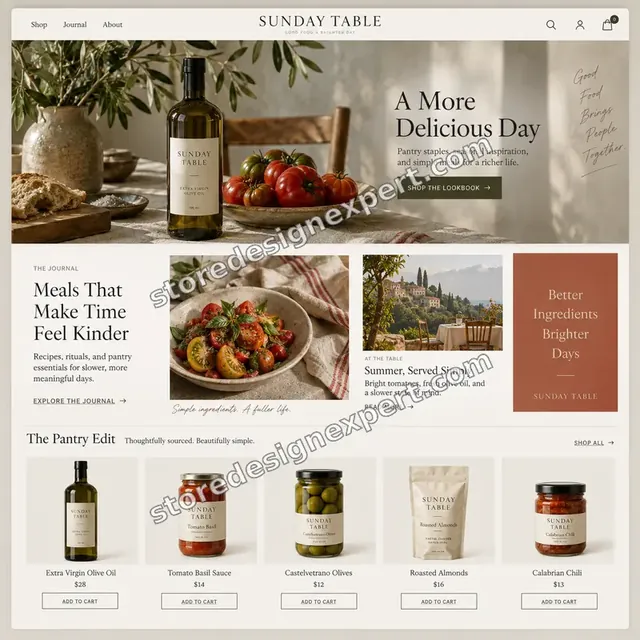
Sunday Table Food Shopify Visual
Food
Sunward Summer fashion Shopify Visual
Summer fashion
Orbit Sound Technology Shopify Visual
Technology
Fine Jewelry Luxury Shopify Store
Fine jewelry and watches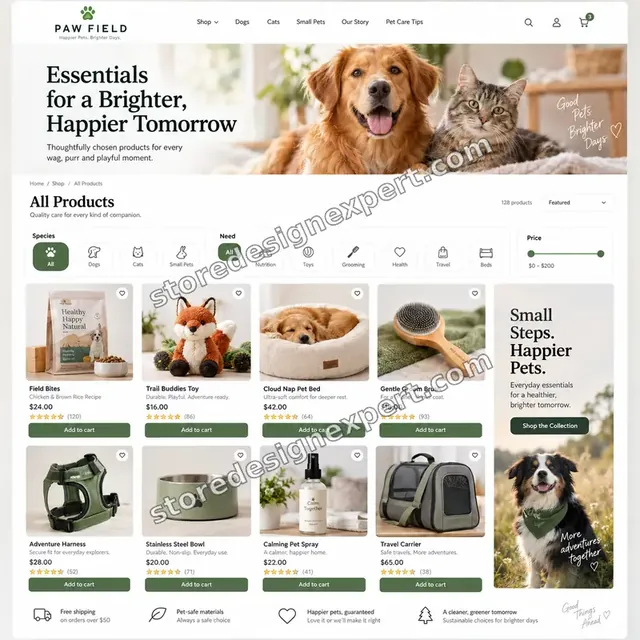
Paw Field Pet Shopify Visual
PetProcess and timeline
From First Call to Live Workflow: Our Shopify Auto Tag Orders Automation Process
We follow the same six steps on every build, which is why the price can be fixed.
- 1
Brief and rules
We start with questions about order tagging: the current process, the people and the failures. Rules follow in plain words, for example: when an order is created, then add tags for country, channel and value.
- 2
Access and platform
Access is narrow and approved by you. We suggest a platform, state what it costs each month and prove the connection with a live read.
- 3
Map the data
The data map covers order tags, shipping country, discount code and line items; formats are checked on both sides and blank values are given a rule.
- 4
Build in a copy
Nothing is built on live orders. The workflow runs on test data first, and you see the plan, plus a recording if useful.
- 5
Test on real cases
We run a discounted order, an international order and an order with mixed items, then refunds and edits, and verify each outcome against what the store shows.
- 6
Go live and hand over
After your approval we turn it on, follow the first live runs, then hand over notes, a diagram and a short recorded tour.
Compare your options
Do It by Hand, Use an App, Build It Yourself or Hire Us for Shopify Auto Tag Orders Automation?
Each route has a place. Read across the rows that matter to you and see which one you would trust with your orders.
| What matters | By hand | Built-in app | No-code platform | Store Design Expert |
|---|---|---|---|---|
| Rules set out and agreed | No | Not often | If you write them | Yes |
| Awkward cases checked | By luck | Rarely | If you test | Yes |
| A unique key stops repeats | Easy to slip | Depends | Possible with effort | Yes |
| Failed runs raise an alert | No | Occasionally | Optional extra | Yes |
| Price known before work starts | Staff time | Subscription only | Plan fees and your time | Yes |
| Documentation and video handover | No | No | No | Yes |
| You own every account | Yes | Yes | Yes | Yes |
| Support after launch | No | Vendor support | Platform support | Included window |
Inside every project
What Keeps Your Store and Data Safe
Careful beats fast when orders and personal data are involved. These are the habits behind every build.
Counts compared, not assumed
After any catch-up we compare counts with the source, so missing or doubled records are caught early.
Secrets kept in a vault
A secure vault holds every key and token; none appear in notes or chat.
Build in a copy, never live
Test data comes first. Live orders and orders are left alone until you sign off.
Failures raise a flag
When a run fails, a named person is told which order and why. Silence is never taken as success.
Plain scope, two revision rounds
Price first, then two structured revision rounds for anything in scope, so no tweak becomes a surprise charge.
A written definition of done
We call it complete when a discounted order, an international order and an order with mixed items work as agreed and the log proves it.
Interactive price calculator
Price Your Shopify Auto Tag Orders Automation
Pick a package, answer three short questions and add any extras. Your total and delivery window update as you click, with nothing hidden until checkout.
Request a custom quote
Projects beyond these packages, such as bespoke integrations, heavy catch-up loads or multi-store designs, are scoped and quoted at a fixed price after a short call.
Request a QuoteChanged your mind? Choose Single Automation, Core Automations or Full Automation Set above to return to the instant calculator.
Packages and comparison
Shopify Auto Tag Orders Automation Package Comparison
Here is each package line by line. When you compare our fee with a marketplace listing for Shopify auto tag orders automation, count how many of these checks the cheaper offer actually names.
| What is included | Single Automation $290 | Core Automations $590Recommended | Full Automation Set $1,090 |
|---|---|---|---|
| Trigger for the event: an order is created | Included | Included | Included |
| One action built: add tags for country, channel and value | Included | Included | Included |
| Retries can never repeat an action | Included | Included | Included |
| Failed runs raise an alert | Included | Included | Included |
| Written test log and video handover | Included | Included | Included |
| Three triggers: an order is created; an order is paid; an order contains a flagged product | Not included | Included | Included |
| The workflow will add tags for country, channel and value, add a paid tag and remove the pending one and add a handling tag for the warehouse | Not included | Included | Included |
| Rules by tag, country and order value | Not included | Included | Included |
| Automatic retries with a daily check | Not included | Included | Included |
| Refund, edit and partial cases built | Not included | Not included | Included |
| A catch-up of earlier orders | Not included | Not included | Included |
| Two weeks of monitoring after go-live | Not included | Not included | Included |
| A runbook your team can follow | Not included | Not included | Included |
| Typical delivery | 3 to 5 days | 4 to 8 days | 7 to 12 days |
The calculator above is the source of truth for your final price and delivery estimate.
Why Store Design Expert
Why Owners Choose Our Shopify Auto Tag Orders Automation Over Doing It Alone
Most of this job is clicking, and you could do it. People hire us because the unglamorous parts, ids, timing and edge cases, decide whether automation helps or hurts.
4.9+ from verified clients
Every review on this page is from a verified Store Design Expert client, which lets you see how projects went first.
Tested on your real cases
Your real scenarios are the test plan: a discounted order, an international order and an order with mixed items.
We live inside Shopify
Orders, refunds, edits and metafields are daily work for us. That is a different skill from knowing an automation tool's menus.
Experience since 2015
A decade and more than 450 stores later, few automation quirks are new to us.
A price you can plan around
You see the cost and extra days for each choice in the calculator. Platform fees are separate, and we estimate them for you.
Notes a colleague can follow
The handover notes say what happens when and why each setting was chosen, so nobody has to guess later.
What we need to get started
Getting Started: What We Ask For
We need a way into your store, a short brief and a decision-maker. Pick the access route that suits you.
Approve a collaborator request
Already selling? Send the store address and accept the request we raise. You stay the owner, we see only what the role permits, and you can remove us at any time.
Starting from nothing? We build first
We can start in our own Partner account, set up the store and the workflow, then transfer ownership to you. A Shopify plan is chosen at the end.
Or share a staff login
A staff account is an option. The collaborator route is still better, as it can be cancelled instantly and involves no shared password.
Access to the other tools
Add us to the tools the workflow uses, or have us create accounts under your email. You stay the owner in both cases.
Examples of the work today
Two or three recent cases are enough. They show us how the process runs in practice.
A decision-maker
Who signs off the rules and the test? And when two rules disagree, which wins? Those two answers are all we need.
Your Shopify owner password and card details never reach us. Changes are made in a copy, and we note every setting we touch.
Testimonials
What Store Owners Say After Working With Us
Read how past projects went before you pick a package.
Verified
Store Design Expert is the best. The work is very professional, they pay close attention to detail and, more importantly, they listen. Their level of cooperation is second to none, and everything was delivered in a very timely manner. I will keep them in mind for future projects.
BN
Barbara N.United States
Verified
I request Store Design Expert every time I have a project. They are professional and give real attention to detail, which makes the work stand out.
LK
Laura K.United States
Verified
They kept communicating until the problem was fully resolved, and the result was great.
HJ
Henry J.United States
Verified
Super helpful and patient. I am new to ecommerce and Store Design Expert talked me through the whole process and even fixed my payment bridging for me!
LR
Lois R.United Kingdom
Verified
I am beyond satisfied! Store Design Expert went above and beyond on my project. Highly recommended!
MD
Michael D.United States
Verified
The experience was tailored to my brand and specifications to the letter. I love the result.
EP
Eric P.United States
Verified
They definitely get the job done. Very patient and understanding throughout the whole project.
BS
Brian S.United States
Verified
Thank you so much to Store Design Expert and the team. My site looks far more appealing to customers, and I will happily recommend your services to other new small businesses.
JS
Jennifer S.United States
Verified
Very patient, informative and transparent, and they did exactly what they said they would do. Thanks for all the help!
RO
Raymond O.United States
FAQ
Questions About Order Tagging Automation
Answers on cost, timing, platforms, safety and what to do when a workflow misbehaves.
How much does Shopify auto tag orders automation cost?
Single Automation costs $290, Core Automations $590 and Full Automation Set $1090. Platform, volume, the number of connected tools and add-ons change the total, and the calculator shows it before you pay. Most projects land between about $290 and $1530, with delivery from 3 to 12 working days. Searches like "auto tag orders automation shopify" describe the same work.
How long does order tagging automation take?
Single Automation takes 3 to 5 working days, Core Automations 4 to 8 and Full Automation Set 7 to 12. The usual variables are how many tools are involved and how quickly you approve the rules and the test. The Sooner and Fastest options shorten the schedule when a date is fixed. This also answers "shopify auto tag orders app".
How many tags can a Shopify order have?
Shopify's help centre says up to 250 tags per order, with each order tag limited to 40 characters. People also search for "hire shopify auto tag orders developer"; the same build answers that too.
What characters can order tags use?
Letters, numbers and hyphens, according to Shopify's help centre. If you typed "shopify auto tag orders zapier", the answer is the same.
Are Shopify tags case-sensitive?
No. VIP and vip are the same tag in Shopify. If you came here from "shopify auto tag orders make.com", this is the page for it.
Can Flow tag old orders?
Flow reacts to new events and does not tag past orders retroactively, so we run a backfill separately. Searches like "shopify auto tag orders n8n" describe the same work.
Why did my tagging workflow stop?
A tag built from variables can be too long or contain invalid characters, which can make the action fail. We validate. You may also see it searched as "shopify auto tag orders expert"; this page covers that too.
Which trigger should I use?
Order created fires for unpaid orders too; order paid waits for payment. We choose by your rule. People also search for "how to automate auto tag orders on shopify"; the work is the same.
Can you tag orders by product?
Yes, with line-item conditions. Related searches such as "shopify auto tag orders workflow", the answer is the same.
Ready when you are
Get Your Shopify Auto Tag Orders Automation Done
If the steps above sound right, pick a package and adjust the calculator. We start once you check out. This page covers Shopify auto tag orders automation.
- Secure checkout
- Two revision rounds
- Test log and walkthrough included