
Shopify stores designed and launched
A careful Gatsby and Shopify build
Gatsby Shopify App, Set Up Once and Checked Properly
A Gatsby Shopify app is a static storefront that pulls products through the Storefront API at build time. The source plugin needs the shop name and a Storefront access token with product, variant and collection read access, set in gatsby-config.js, and exposes products as GraphQL nodes. Plugin versions and default API versions conflict, so we pin and test, from $390.
- Source plugin configured with a scoped Storefront token
- Product pages built from GraphQL nodes
- Rebuild webhook on product changes
- Test log and a recorded handover
From$390
Delivery3 to 14 working days
Revisions2 rounds
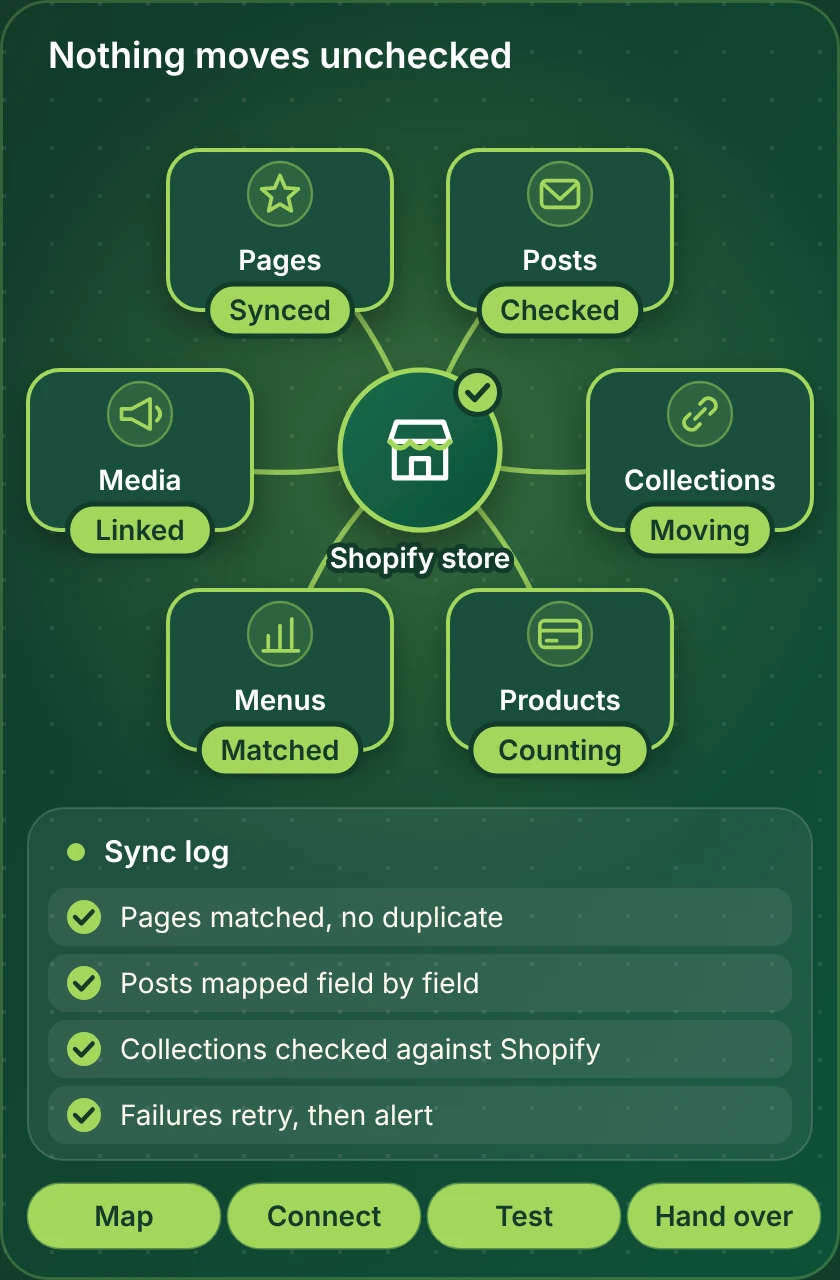
Our track record
Over 450 Stores Built Since 2015. Here Is What That Means for Your Gatsby Link.
A decade spent in hundreds of Shopify stores pays off in small decisions: what to key each record to, when to retry, which side wins a conflict. Those decisions keep a website or content platform integration quiet and reliable.
Average rating from verified clients
Building Shopify stores since
Secure checkout
Pay through a protected checkout and keep a full order record.
Two revision rounds
Included in every package, so the result matches what you pictured.
Backup before changes
We work on a duplicate of your theme, never on your live store.
Who this is for
Six Kinds of Store We Build Gatsby Shopify App For
Static storefronts are fast but go stale without rebuild triggers. These are the cases we build for.
You are a good fit if
- Your store runs on Shopify
- You have, or will open, a Gatsby account
- You want a fixed price and a written scope
- You can share the access we ask for
Developers building static stores
Products and variants appear as GraphQL nodes at build time.
Teams creating tokens
A Storefront token needs read access to products, variants and collections.
Multi-language stores
gatsby-source-shopify-multi-language adds translations.
Teams picking a plugin
Several forks exist; default API versions differ between listings.
Stores with frequent changes
A webhook must trigger a rebuild when products change.
Stores needing checkout
The cart and checkout use the Storefront API, not static data.
Problems solved
Gatsby Shopify App: Six Faults We Fix First
Static builds fail on tokens, versions and freshness. These are the six faults we fix.
The problem
Over-broad token
The outcome
Risk grows. We scope reads.
The problem
Wrong API version
The outcome
Fields change. We pin.
The problem
Stale prices
The outcome
Pages lag. We rebuild on webhook.
The problem
Fork confusion
The outcome
Plugins disagree. We choose one.
The problem
Cart not wired
The outcome
Checkout fails. We connect Storefront cart.
The problem
No handover
The outcome
Config is unwritten. We document it.
What we can do
Gatsby Shopify App: What We Set Up Inside Gatsby and Shopify
How we build a Gatsby Shopify store, in order.
Token
Scoped.
Plugin
Config.
Pages
From nodes.
Rebuild
Webhook.
Tests
Build and cart.
Handover
Notes and recording.
What is included
What Is Inside Your Gatsby Integration
Six groups, four checks each. Compare them with any quote you have and see which ones it names.
Connection
- Gatsby linked through an application key or a connected account
- Health check on a schedule
- Roles and permissions reviewed with you
- Shopify permissions kept to the minimum
Triggers
- Order of events checked
- Trigger for the moment a collection changes
- Each trigger tested on its own
- Rules by tag, country or order value
Mapping
- Image mapped, with blanks handled
- Handle and price matched, formats included
- Custom field mapping where required
- Mapping table kept in the notes
Safety
- We stay inside rate limits
- Retries that update, not duplicate
- A daily check catches silent stops
- Consent flags carried across
Testing
- Check against a product publish
- Edge cases: refunds and edits
- First live runs watched
- Check against a price update
Handover
- Screen-recorded tour of the flow
- Help with questions after go-live
- A diagram of the data paths
- Account kept in your name
Your part is access, a brief and a decision on conflicts. Ours is the build, the test and the handover.
What we connect and check
Gatsby and Shopify: How the Connection Is Wired
See the build as a short chain: event, check, write, log. Each link is tested on its own and again as a whole, with real orders, before we ask you to approve anything.
Portfolio
Stores We Designed, Ready to Connect to Gatsby
Integrations sit behind the storefront, so here is the storefront we build. Picture each store below with pages flowing into Gatsby.

LED Skincare Mask One-Product Store
Beauty technology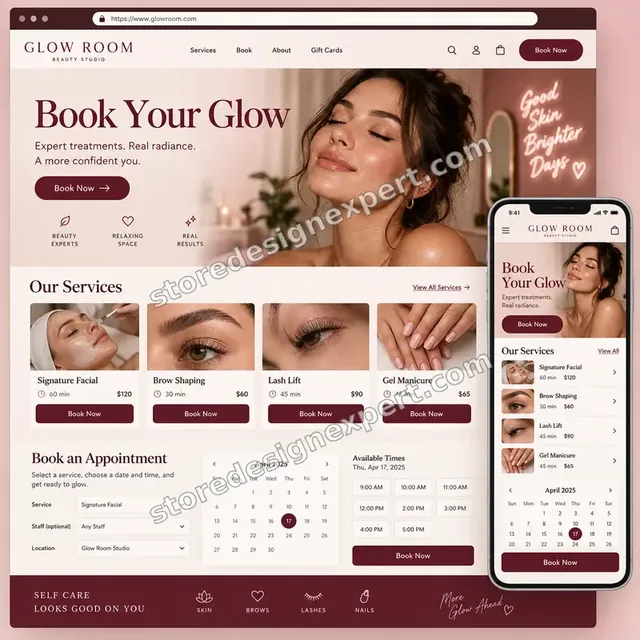
Glow Room Beauty studio Shopify Visual
Beauty studio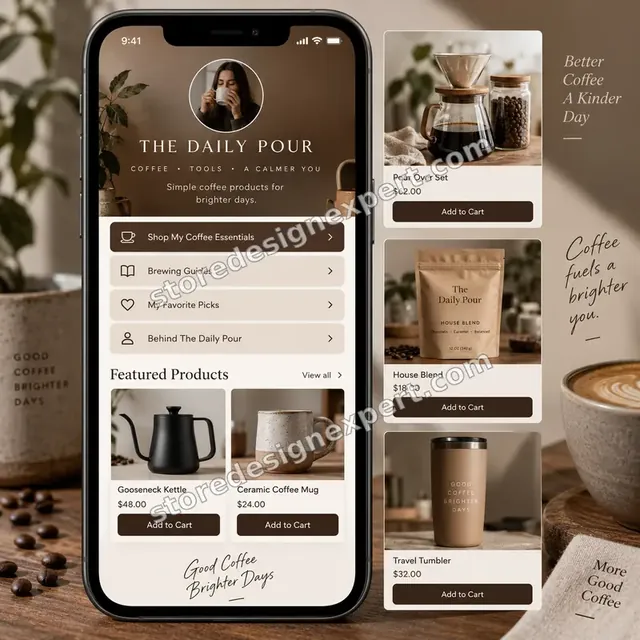
The Daily Pour Coffee creator Shopify Visual
Coffee creator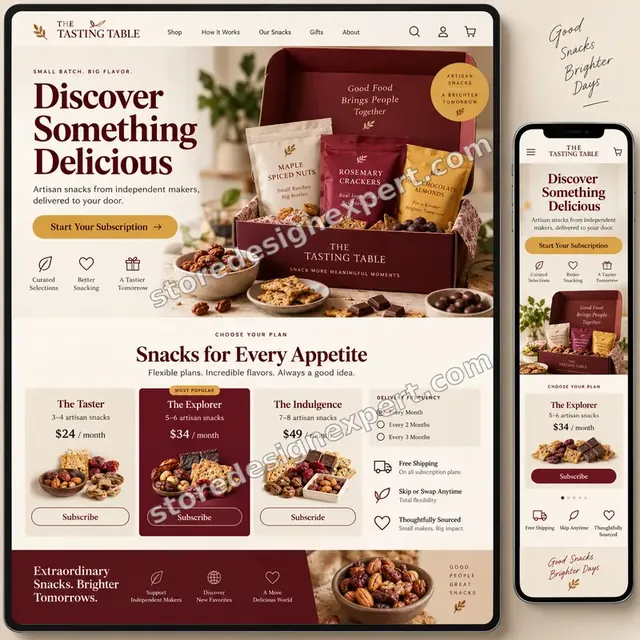
The Tasting Table Artisan snacks Shopify Visual
Artisan snacks
Wag & Wild Pet Shopify Visual
Pet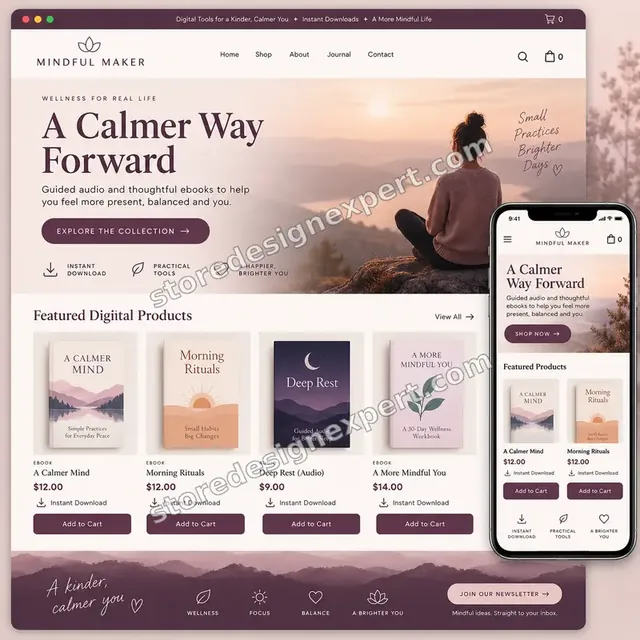
Mindful Maker Wellness ebooks Shopify Visual
Wellness ebooksProcess and timeline
Six Stages From Brief to Live Gatsby Sync
Six stages, in order. Nothing touches live data until you have seen it work on a copy, and your calculator choices decide how long each stage takes.
- 1
Brief and scope
We start with questions: what you sell, how Gatsby fits your day and which events matter. Reading through your orders and pages shows where the flow begins and what it must never touch.
- 2
Access and connection
You approve narrow access to Shopify and Gatsby, using an application key or a connected account. We confirm the connection with a live read before building on it.
- 3
Map and rule
Product title, handle, price and image are matched across both tools, and we record who wins each conflict and how blanks are treated.
- 4
Build in a copy
The flow is built against test data, never your live records. You see the plan and, where useful, a recorded run.
- 5
Test on real cases
We test a product publish, a collection change and a price update, plus refunds and edits, then compare the results with what Shopify shows.
- 6
Go live and hand over
On your approval the flow is switched on and monitored through its first runs, and you receive notes, a diagram and a quick video tour.
Compare your options
Four Ways to Connect Gatsby and Shopify, Compared
Each route has a place. Look along the rows that matter to you and see which one you would trust with your orders.
| What matters | Gatsby app or DIY | Automation platform | Freelance gig | Store Design Expert |
|---|---|---|---|---|
| Fields mapped on purpose | Out-of-the-box fields | Yes, if you build it | Varies | Yes |
| Unique key stops duplicate records | Rarely handled | If you add it | Not usually | Yes |
| A named person hears about failures | No | Only if you add it | Seldom | Yes |
| Refunds and edits included in testing | Not often | If you test | Hit and miss | Yes |
| Cost agreed before any work | Plan fees only | Plan fees plus your time | Yes | Yes |
| Notes and a recorded walkthrough | No | No | Not usually | Yes |
| Accounts stay in your name | Yes | Yes | Depends | Yes |
| Help after go-live | Vendor support | Help desk of the platform | Often none | Included window |
Inside every project
How We Protect Your Orders and Customer Data
Careful beats fast when personal data is involved. These are the habits behind every build.
A written definition of done
We call it complete when a product publish, a collection change and a price update work as agreed and the log proves it.
Failures raise a flag
A named person receives an alert, with the order and the reason, whenever a run fails.
Secrets kept in a vault
Keys and tokens live in a secure vault, not in notes, spreadsheets or chat.
Counts compared, not assumed
After any load we compare counts with the source, so missing or doubled records are caught early.
Build in a copy, never live
Everything is built and tested on test data, so your live orders and pages stay untouched until you approve.
Plain scope, two revision rounds
Price first, then two structured revision rounds for anything in scope, so no tweak becomes a surprise charge.
Interactive price calculator
Build Your Gatsby Integration Package
Choose a package, tell us about your order volume, data direction and existing Gatsby data, then pick a speed. The fixed price and delivery window update with each selection.
Request a custom quote
If your Gatsby setup relies on custom code, a private API, an on-premise system or more than one store, send a short brief and we will quote it as a fixed-price project.
Request a QuoteChanged your mind? Choose Single Workflow, Core Workflows or Full Integration above to return to the instant calculator.
Packages and comparison
Gatsby Integration Package Comparison
Here is each package line by line. When you compare our fee with a marketplace listing for Gatsby Shopify app, count how many of these checks the cheaper offer actually names.
| What is included | Single Workflow $390 | Core Workflows $790Recommended | Full Integration $1,490 |
|---|---|---|---|
| Gatsby linked with an application key or a connected account | Included | Included | Included |
| A trigger for when a site rebuild is triggered | Included | Included | Included |
| Field map covering product title, handle and price | Included | Included | Included |
| Retries can never create a second record | Included | Included | Included |
| Test log plus a recorded walkthrough | Included | Included | Included |
| Three triggers: a site rebuild is triggered; a product is published; a collection changes | Not included | Included | Included |
| Image and custom fields mapped | Not included | Included | Included |
| Filters by tag, country and value | Not included | Included | Included |
| Retries, plus an alert when a run fails | Not included | Included | Included |
| Two-way sync, each field with its own rule | Not included | Not included | Included |
| Past pages loaded in one pass | Not included | Not included | Included |
| Two weeks of monitoring after go-live | Not included | Not included | Included |
| Written runbook for your team | Not included | Not included | Included |
| Typical delivery | 3 to 5 days | 5 to 9 days | 8 to 14 days |
The calculator above is the source of truth for your final price and delivery estimate.
Why Store Design Expert
Why Hire Us to Connect Gatsby and Shopify
Templates cover the happy path. We cover the rest, and we put the result in writing.
Safety designed in
Every build includes retries, alerts, unique keys and narrow access; none are paid extras.
4.9+ from verified clients
The reviews here come from verified clients of Store Design Expert, so you can judge past projects before you pay.
Tested on your real cases
We test the cases your store actually has, such as a product publish, a collection change and a price update.
Experience since 2015
We have launched more than 450 Shopify stores since 2015 and met most of the quirks that trip up integrations.
A price you can plan around
The calculator shows the price and extra days for every package and option. Gatsby bills its own plan fees, so check its current pricing page.
We live inside Shopify
Daily work on orders, refunds and metafields gives us Shopify depth that Gatsby menus alone do not.
What we need to get started
What We Need From You to Begin
Three things get the work moving: safe access, a few answers and a decision-maker. Here is the detail.
Approve a collaborator request
If the store is live, send us its address and approve our request. Ownership stays with you, our role is limited, and removal takes one click.
Starting from nothing? We build first
Without a store, we build one in a Partner account with Gatsby connected, then transfer it to you. You pick a plan once everything works.
Or share a staff login
Sharing a staff login is possible. The collaborator route is safer, though: one click removes it and no password is passed around.
Your Gatsby access
Either create the Gatsby account yourself and add us, or we open it with your email. You remain the owner, and we work through an application key or a connected account.
Sample records
Two or three representative records from each side are enough. They show us the true shape of your data.
A decision-maker
Tell us who approves the plan and the test, and which rule should win when Gatsby and Shopify disagree.
We never need your owner password or payment details. Access is limited, logged and removable at any time.
Testimonials
What Store Owners Say After Working With Us
Verified clients describe the brief, the build and the handover in their own words.
Verified
Store Design Expert is the best. The work is very professional, they pay close attention to detail and, more importantly, they listen. Their level of cooperation is second to none, and everything was delivered in a very timely manner. I will keep them in mind for future projects.
BN
Barbara N.United States
Verified
They kept communicating until the problem was fully resolved, and the result was great.
HJ
Henry J.United States
Verified
Super helpful and patient. I am new to ecommerce and Store Design Expert talked me through the whole process and even fixed my payment bridging for me!
LR
Lois R.United Kingdom
Verified
I am beyond satisfied! Store Design Expert went above and beyond on my project. Highly recommended!
MD
Michael D.United States
Verified
The experience was tailored to my brand and specifications to the letter. I love the result.
EP
Eric P.United States
Verified
They definitely get the job done. Very patient and understanding throughout the whole project.
BS
Brian S.United States
Verified
Thank you so much to Store Design Expert and the team. My site looks far more appealing to customers, and I will happily recommend your services to other new small businesses.
JS
Jennifer S.United States
Verified
Very patient, informative and transparent, and they did exactly what they said they would do. Thanks for all the help!
RO
Raymond O.United States
Verified
Store Design Expert is the only one I use for all things WordPress. They have a high level of understanding, deliver quality work and are easy to deal with.
SC
Scott C.United States
FAQ
Gatsby Integration FAQs
Answers on cost, timing, access, data and what to do when the connection misbehaves.
How much does Gatsby Shopify app cost?
Single Workflow costs $390, Core Workflows $790 and Full Integration $1490. Order volume, data direction, existing Gatsby data and add-ons change the total, and the calculator shows it before you pay. Most projects land between about $390 and $2090, with delivery from 3 to 14 working days.
How long does the Gatsby integration take?
Single Workflow takes 3 to 5 working days, Core Workflows 5 to 9 and Full Integration 8 to 14. The usual variables are how much history you want loaded and how quickly you approve the test results. The Sooner and Fastest options shorten the schedule when a launch date is fixed.
How does Gatsby get Shopify data?
Through a source plugin using the Storefront API.
What does the token need?
Read access to products, variants and collections. You may also see it searched as "gatsby source shopify storefront token"; this page covers that too.
Which plugin should I use?
Several exist; we choose and pin one. If you came here from "shopify to gatsby sync", you are in the right place.
Do prices update automatically?
Only with a rebuild trigger. Another way to phrase it: "connect shopify and gatsby"; the same build answers that too.
Does it support multiple languages?
A multi-language plugin exists. Queries such as "gatsby shopify zapier" lead to the same build.
Are the docs official?
Our results were registry and GitHub pages. If you typed "gatsby shopify make.com", the answer is the same.
Can you build it?
Yes. This also answers "gatsby shopify n8n".
Ready when you are
Book Your Gatsby Shopify App Build
Select a package, watch the fixed price settle and book a Gatsby Shopify app build from a team that has launched 450+ Shopify stores. The connection is tested on real cases before you are asked to approve anything.
- Secure checkout
- Two revision rounds
- Test log and walkthrough included