
Shopify stores designed and launched
Fixed-price Shopify customer tagging, segmentation and RFM
Shopify Customer Segmentation Automation, Rules Written Down, Runs Logged
Shopify customer segmentation automation keeps your customer groups current without anyone exporting a list: VIPs, lapsed buyers, first-timers, high-spenders and RFM groups, written as segment queries and mirrored to tags and email lists. Shopify's segments use a ShopifyQL WHERE clause and include an RFM group attribute. We design the segments, connect them to your tools and test the results, from $290.
- Segments written in Shopify's segment query language, checked against real customers
- RFM groups defined from recency, frequency and spend or the built-in group attribute
- Segments mirrored to tags and your email platform
- Test log and a recorded handover
From$790
Delivery4 to 20 working days
Revisions2 rounds
Our track record
Over 450 Stores Built Since 2015. Here Is What That Means for Your Automation.
Experience shows in small decisions: which event to trigger on, when to retry, what to log. Those decisions keep customer tagging, segmentation and RFM calm and trouble-free.
Average rating from verified clients
Building Shopify stores since
Secure checkout
Pay through a protected checkout and keep a full order record.
Two revision rounds
Included in every package, so the result matches what you pictured.
Backup before changes
We work on a duplicate of your theme, never on your live store.
Who this is for
Six Kinds of Store That Book Shopify Customer Segmentation Automation
Segments are only useful if they stay accurate. These are the cases we build for.
You are a good fit if
- Your orders come through Shopify
- You know roughly how the task runs today
- You would rather pay once than by the hour
- You can review a test run with us
Marketers sending to everyone
Segments by spend, frequency and recency let you send different messages to different people.
Stores with a VIP programme
VIP status is a segment, not a spreadsheet.
Owners with lapsed customers
A segment of people who have not ordered for a set time feeds win-back.
Teams wanting RFM
Shopify's attribute reference includes an RFM group. We check it and add our own where needed.
Teams using an email platform
Segments are mirrored so the email tool matches Shopify.
Owners with stale tags
Tags added once never expire. We refresh them.
Problems solved
What Breaks in Customer Tagging, Segmentation and RFM Automation, and the Fix for Each
Segmentation breaks by going stale. These are the six faults we fix.
The problem
Out-of-date lists
The outcome
Segments are live; exports are not. We mirror.
The problem
Unclear definitions
The outcome
Recent and frequent mean nothing without numbers. We set them.
The problem
Overlapping segments
The outcome
Customers appear in several. We make them exclusive where needed.
The problem
Stale tags
The outcome
We expire them.
The problem
Email tool mismatch
The outcome
We keep both in step.
The problem
Nobody knows the rules
The outcome
We document.
What we can do
What Our Shopify customer segmentation automation Work Includes, Piece by Piece
How we build segmentation, in order.
Definitions
Numbers for recent, frequent and valuable.
Segment queries
WHERE clauses written and tested.
Mirroring
Tags and email lists.
Refresh
Schedules and expiry.
Checks
Counts compared with Shopify.
Handover
Notes and recording.
What is included
The Customer Tagging, Segmentation and RFM Checklist, Group by Group
Here is the full list, grouped by job. Entry packages cover the first items in each group; bigger ones go further.
Design
- Plain-English rules, approved by you
- Platform picked, with a cost estimate
- A list of triggers and conditions
- Owner named for every step
Triggers
- Order of events checked
- Event handled: a customer goes quiet
- Filters set by tag, country or value
- Trigger built for when a customer reaches a spend level
Actions
- Last order date and tags mapped, blanks handled
- Wording approved before go-live
- Order count and total spent mapped, formats included
- Step built to update recency, frequency and value
Safety
- Platform limits respected
- Consent and opt-outs honoured
- Every step keyed to the Shopify id
- Retries that do not repeat actions
Testing
- Test on a repeat buyer
- Edge cases: refunds and edits
- Scenario tested: a first-time buyer
- First live runs watched
Handover
- Two rounds of changes included
- Accounts stay yours
- Help with questions after go-live
- Every rule explained in writing
Your part is access, a brief and a decision on the rules. Ours is the build, the test and the handover.
What we build and check
From Trigger to Result: How Customer Tagging, Segmentation and RFM Is Automated
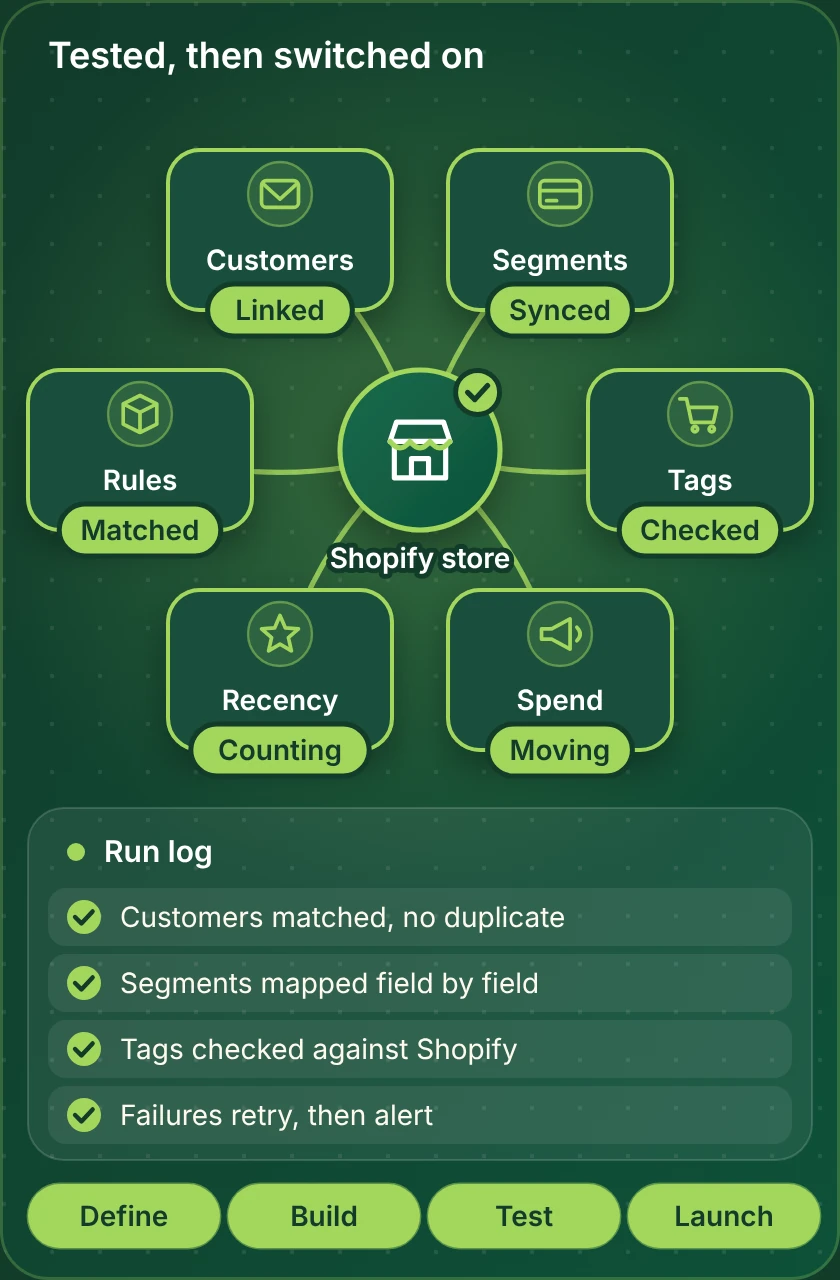
Every automation follows the same path. An event arrives, the rules decide what applies, the action runs and the result is logged where your marketing team can see it. The map shows the pieces we build and test before handover.
Portfolio
Shopify Stores We Have Built, Ready for Automation
We build the stores and the workflows behind them. These launches show the standard your automation will be built on.
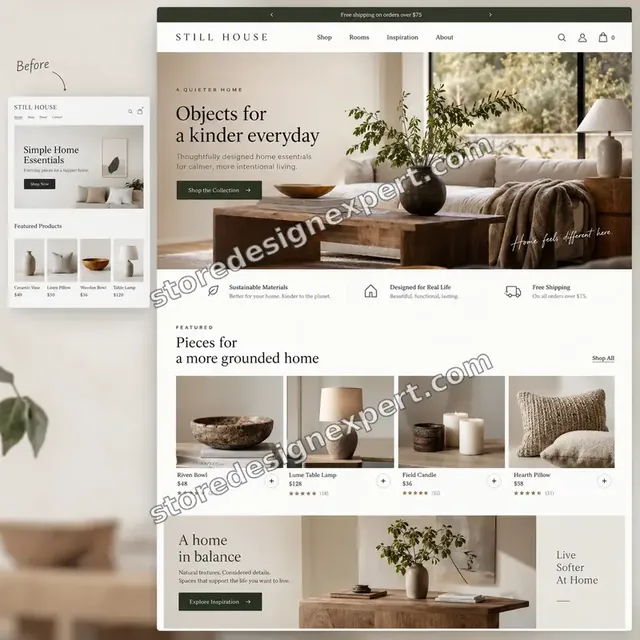
Still House Home decor Shopify Visual
Home decor
Amora Fine Jewelry Shopify Visual
Jewelry
First Light Coffee Shopify Visual
Coffee
Specialty Coffee Subscription Shopify Store
Specialty coffee
Fine Arc Jewelry Shopify Visual
Jewelry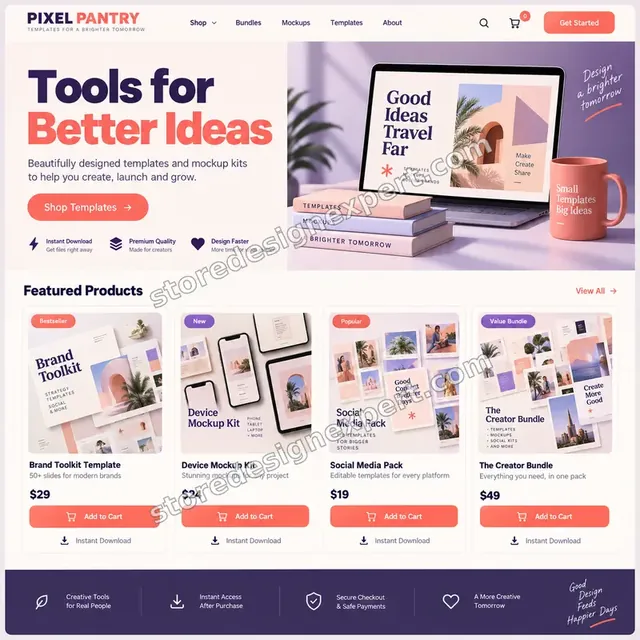
Pixel Pantry Design templates Shopify Visual
Design templatesProcess and timeline
How We Build Your Customer Tagging, Segmentation and RFM Automation, Step by Step
A fixed order of work keeps the project predictable. You know what happens next at every point.
- 1
Brief and rules
We ask how customer tagging, segmentation and RFM works today, who does what and where it goes wrong. Together we write each rule in plain words: when an order is paid, then update recency, frequency and value.
- 2
Access and platform
Access is narrow and approved by you. We suggest a platform, state what it costs each month and prove the connection with a live read.
- 3
Map the data
The data map covers order count, total spent, last order date and tags; formats are checked on both sides and blank values are given a rule.
- 4
Build in a copy
The workflow is built against test data, never your live orders. You see the plan and, where useful, a recorded run.
- 5
Test on real cases
We test a first-time buyer, a repeat buyer and a lapsed buyer, plus refunds and edits, then compare the results with what Shopify shows.
- 6
Go live and hand over
On your approval the workflow is switched on and monitored through its first runs, and you receive notes, a diagram and a quick video tour.
Compare your options
Which Route Fits: Manual, App, Platform or Specialist Build?
The cheapest route is not always the cheapest outcome. These rows show where the differences appear.
| What matters | Do it by hand | Basic app or Flow | Platform you build | Store Design Expert |
|---|---|---|---|---|
| Written, agreed rules | No | Not often | When you write them | Yes |
| Awkward cases checked | If someone remembers | Seldom | When you test | Yes |
| Retries cannot repeat actions | Prone to slips | Hit and miss | If you add it | Yes |
| Failed runs raise an alert | No | Sometimes | If you add it | Yes |
| You see the cost before we begin | Staff time | Plan fees only | Plan fees plus your time | Yes |
| Documentation and video handover | No | No | No | Yes |
| Ownership stays with you | Yes | Yes | Yes | Yes |
| Support after launch | No | Help desk of the vendor | Platform help desk | Included for a period |
Inside every project
What Keeps Your Store and Data Safe
Careful beats fast when orders and personal data are involved. These are the habits behind every build.
Failures raise a flag
A failed run alerts a named person with the order and the reason. Silence never means success.
Counts compared, not assumed
We check totals against the source after each catch-up, so mismatches surface straight away.
Nothing sent without approval
Emails, texts and posts that reach customers are approved by you before they are enabled.
Narrow access, in your name
The smallest workable access, with all accounts in your name.
Build in a copy, never live
Everything is built and tested on test data, so your live orders and customers stay untouched until you approve.
Secrets kept in a vault
Tokens and keys are stored in a secure vault, never pasted into notes or chat.
Interactive price calculator
Build Your Customer Tagging, Segmentation and RFM Package
Choose a package, tell us which platform you prefer, how busy the store is and how many tools are involved, then pick a speed. The fixed price and delivery window update with each selection.
Request a custom quote
Workflows that span many systems, need custom code, handle very high volumes or depend on an on-premise system are quoted separately at a fixed price.
Request a QuoteChanged your mind? Choose Single Build, Core Build or Full Build above to return to the instant calculator.
Packages and comparison
Shopify Customer Segmentation Automation Package Comparison
Here is each package line by line. When you compare our fee with a marketplace listing for Shopify customer segmentation automation, count how many of these checks the cheaper offer actually names.
| What is included | Single Build $790 | Core Build $1,590Recommended | Full Build $2,990 |
|---|---|---|---|
| One trigger built: when an order is paid | Included | Included | Included |
| First action built: update recency, frequency and value | Included | Included | Included |
| Retries can never repeat an action | Included | Included | Included |
| A named person hears about failures | Included | Included | Included |
| A log of the tests and a short recorded tour | Included | Included | Included |
| Events handled: an order is paid; a customer reaches a spend level; a customer goes quiet | Not included | Included | Included |
| Actions to update recency, frequency and value; tag the customer into the right segment; and move the customer to a win-back segment | Not included | Included | Included |
| Filtering on tags, countries and totals | Not included | Included | Included |
| Retries and daily health check | Not included | Included | Included |
| Awkward cases built in | Not included | Not included | Included |
| One-off catch-up of past customers | Not included | Not included | Included |
| Two weeks of monitoring after go-live | Not included | Not included | Included |
| Team runbook in plain English | Not included | Not included | Included |
| Typical delivery | 4 to 7 days | 7 to 12 days | 11 to 20 days |
The calculator above is the source of truth for your final price and delivery estimate.
Why Store Design Expert
What You Get From Us That a Template Does Not
Templates cover the happy path. We cover the rest, and we put the result in writing.
A price you can plan around
You see the cost and extra days for each choice in the calculator. Platform fees are separate, and we estimate them for you.
A direct line to the builder
You talk to the person working on your workflow, and questions about a rule or field get a plain answer.
4.9+ from verified clients
The reviews here come from verified clients of Store Design Expert, so you can judge past projects before you pay.
Tested on your real cases
Tests use the cases your store really sees, for example a first-time buyer, a repeat buyer and a lapsed buyer.
We live inside Shopify
Orders, refunds, edits and metafields are daily work for us. That is a different skill from knowing an automation tool's menus.
Safety designed in
Safety is standard: retries, alerts, unique keys and narrow access are part of each build.
What we need to get started
What to Prepare Before We Start Your Customer Tagging, Segmentation and RFM Automation
The list is short. Most owners have everything ready in a day.
Approve a collaborator request
Already trading? Share the store address and accept our collaborator request. You remain the owner, we see only what the role allows, and you can remove us whenever you like.
Starting from nothing? We build first
No store yet? We build it in our Partner account, set up the workflow there and transfer the whole store to you, so you choose a plan only at the end.
Or share a staff login
Sharing a staff login is possible. The collaborator route is safer, though: one click removes it and no password is passed around.
Access to the other tools
Invite us to the tools involved or let us set up accounts with your email. In both cases you keep the owner role.
Examples of the work today
Share a few recent cases, or point us to them. Real examples reveal how the process really runs.
A decision-maker
We need one person to approve the rules and the test, plus a ruling for when two rules clash.
We never need your owner password or payment details. Access is limited, logged and removable at any time.
Testimonials
Client Words, Not Ours
Verified clients describe the brief, the build and the handover in their own words.
Verified
Store Design Expert delivered an outstanding website development experience! Their professionalism and attention to detail exceeded my expectations, and their proactive communication kept everything running smoothly. Truly impressed by their deep understanding and dedication.
WG
Warren G.United States
Verified
The website development work was nothing short of professional, with top-notch quality. Their exceptional level of cooperation made the collaboration seamless and enjoyable. Highly recommend working with Store Design Expert!
JC
Jeremy C.United States
Verified
Super great to work with, and super fair!
RO
Robert O.United States
Verified
The website development work was truly impressive. Their attention to detail and ability to exceed expectations made the project a success. Working with them was a breeze, thanks to quick responsiveness and a willingness to go above and beyond.
KD
Kevin D.United States
Verified
Store Design Expert was very knowledgeable about what I needed done to fix my Shopify store and how to improve the store layout. The project was completed very quickly, and I will definitely use them for support as my business grows.
ST
Samuel T.United States
Verified
Very satisfied with the work. Most importantly, Store Design Expert responded promptly to my questions and concerns. Thank you!
KB
Kyle B.United States
Verified
Outstanding work and outstanding customer service. Five stars! I will absolutely use Store Design Expert again for my next book.
KM
Katharine M.United States
Verified
Store Design Expert was great! They delivered exactly what I asked for and even offered helpful extra suggestions. Highly recommended.
PW
Paul W.United States
Verified
I request Store Design Expert every time I have a project. They are professional and give real attention to detail, which makes the work stand out.
LK
Laura K.United States
FAQ
Questions About Customer Tagging, Segmentation and RFM Automation
Answers on cost, timing, platforms, safety and what to do when a workflow misbehaves.
How much does Shopify customer segmentation automation cost?
Single Build costs $790, Core Build $1590 and Full Build $2990. Platform, volume, the number of connected tools and add-ons change the total, and the calculator shows it before you pay. Most projects land between about $790 and $4190, with delivery from 4 to 20 working days. This also answers "shopify customer segmentation expert".
How long does customer tagging, segmentation and RFM automation take?
Single Build takes 4 to 7 working days, Core Build 7 to 12 and Full Build 11 to 20. The usual variables are how many tools are involved and how quickly you approve the rules and the test. The Sooner and Fastest options shorten the schedule when a date is fixed. You may also see it searched as "shopify customer segmentation workflow"; the work is the same.
How do Shopify customer segments work?
They are filters written in a subset of ShopifyQL using the WHERE clause. If you typed "how to automate customer segmentation on shopify", this is the page for it.
Does Shopify have RFM segments?
The attribute reference lists an RFM group. A third-party guide says there is no dedicated score and recreates it from filters. We check your admin. If you came here from "shopify app for customer segmentation", this is the page for it. The same service covers "hire shopify customer segmentation developer".
Can segments trigger automation?
A third-party blog says Flow can act on segment triggers on Plus, but we could not confirm it. We verify. Searches like "shopify crm features: customer segmentation" point to this service. The same service covers "shopify customer segmentation app".
Can I segment by email engagement?
The reference includes email-engagement functions such as opened and clicked. Queries such as "shopify apps customer segmentation" lead to the same build. Related searches such as "customer segmentation automation shopify", this is the page for it.
Can segments feed my email tool?
Yes, we mirror them. Another way to phrase it: "shopify customer segmentation zapier"; the work is the same.
How often should segments refresh?
We set a schedule that matches your campaigns. This also answers "shopify customer segmentation make.com".
Can you create RFM for me?
Yes. If you typed "shopify customer segmentation n8n", you are in the right place.
Ready when you are
Ready to Automate Customer Tagging, Segmentation and RFM?
You have seen the process, the safeguards and the price. The next step is to choose a package and tell us how your store works. This page covers Shopify customer segmentation automation.
- Secure checkout
- Two revision rounds
- Test log and walkthrough included