
Shopify stores designed and launched
Done-for-you Skyvia and Shopify connection
Shopify Skyvia Integration, Quietly Reliable From Day One
Skyvia moves Shopify data in and out: scheduled CSV exports to file storage, imports from CSV, and replication of orders and products into databases such as MySQL, SQL Server, Snowflake, Databricks and BigQuery. A Shopify Skyvia integration is a data pipeline, and pipelines are judged by whether the numbers match. We build, reconcile and document it, from $590.
- Replication or CSV export chosen for the job: live copy, backup or report
- Orders and products replicated into your database with a history setting decided per object
- Row counts and totals reconciled against Shopify
- Test log and a recorded handover
From$690
Delivery3 to 16 working days
Revisions2 rounds
Our track record
Launched 450+ Shopify Stores Since 2015. Now We Connect Them to the Tools You Run.
A store is as useful as the systems around it. Our integration work comes out of years spent inside Shopify, so we can tell what a clean order looks like before it reaches Skyvia.
Average rating from verified clients
Building Shopify stores since
Secure checkout
Pay through a protected checkout and keep a full order record.
Two revision rounds
Included in every package, so the result matches what you pictured.
Backup before changes
We work on a duplicate of your theme, never on your live store.
Who this is for
Who Our Shopify Skyvia Integration Service Is For
Skyvia is picked by teams that want Shopify data in a database or in files. These are the cases we handle.
You are a good fit if
- Your store runs on Shopify
- You have, or will open, a Skyvia account
- You want a fixed price and a written scope
- You can share the access we ask for
Teams that want a reporting database
Replication copies Shopify objects such as orders and products into SQL Server, MySQL, BigQuery, Snowflake or Databricks and creates the tables for you.
Owners wanting scheduled backups
Skyvia can export Shopify data to CSV on a schedule, to local or cloud storage, compressed if needed.
Teams bulk-importing products
Nested product and order structures make imports hard to map. We design the import and test on a small batch first.
Analysts watching warehouse cost
History mode keeps old record versions but adds storage. We decide per object whether it is worth it.
Owners whose export was incomplete
Filters and date ranges decide what leaves Shopify. We check counts.
Teams handing reports to finance
We document what each table means and where it comes from.
Problems solved
Six Faults a Careful Shopify Skyvia Integration Avoids
Data pipelines fail quietly because the numbers look plausible. These are the faults we look for.
The problem
Counts that do not match Shopify
The outcome
Filters, timezones and deleted records cause gaps. We reconcile.
The problem
Nested fields flattened badly
The outcome
Orders contain line items, refunds and discounts. We model each separately.
The problem
Duplicate rows
The outcome
We choose a key and enforce it.
The problem
History mode left on everywhere
The outcome
Storage grows. We choose per object.
The problem
Stale data
The outcome
Schedules decide freshness. We set them to your reporting need.
The problem
Unlabelled tables
The outcome
We write a data dictionary.
What we can do
Shopify Skyvia Integration: What We Set Up Inside Skyvia and Shopify
What we put into a Skyvia and Shopify pipeline.
Replication design
Which objects, which target, which refresh and which history setting.
Export and import
CSV schedules, filters and compression, plus safe bulk imports.
Reconciliation
Counts and totals compared against Shopify.
Failure alerts
Failed runs notify a named person.
Data dictionary
What each table and column means.
Handover
Notes and a recorded walkthrough.
What is included
Everything Included in Our Shopify Skyvia Integration Packages
Deliverables fall into six groups. The package table below shows how much of each group a given price covers, so the difference between tiers is easy to judge.
Connection
- Roles and permissions reviewed with you
- Secrets kept in a vault, not in a note
- Live read before we build
- Narrow Shopify access for this flow
Triggers
- Order of events checked
- Every trigger proven separately
- Event handled: a schedule runs
- Flow starts when an order is created
Mapping
- Extra fields mapped on request
- Who wins each field, in writing
- Formats agreed for target and mapping
- Schedule handled, including blanks
Safety
- Failure alerts to a named person
- Throttling within limits
- Daily check for silent stops
- A retry never creates a second record
Testing
- Tested with an incremental load
- We watch the first live runs
- Test log handed over
- Test on a schema change
Handover
- Every setting explained in writing
- Help with questions after go-live
- Screen-recorded tour of the flow
- Revisions: two rounds included
You approve the plan and the test. We do the rest and hand you the notes.
How the link works
What Happens When a schedule runs: The Skyvia Flow
Picture the build as a short chain: event, check, write, log. Each link is tested on its own and again as a whole, with real orders, before we ask you to approve anything.
Portfolio
Our Store Work Behind Your Skyvia Integration
We build the stores and the links behind them. These launches show the standard your Skyvia connection will be built on.
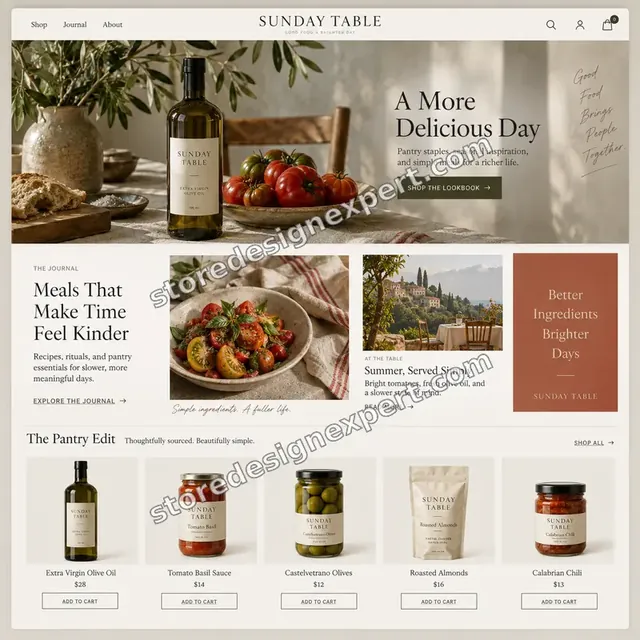
Sunday Table Food Shopify Visual
Food
Sunward Summer fashion Shopify Visual
Summer fashion
Orbit Sound Technology Shopify Visual
Technology
Fine Jewelry Luxury Shopify Store
Fine jewelry and watches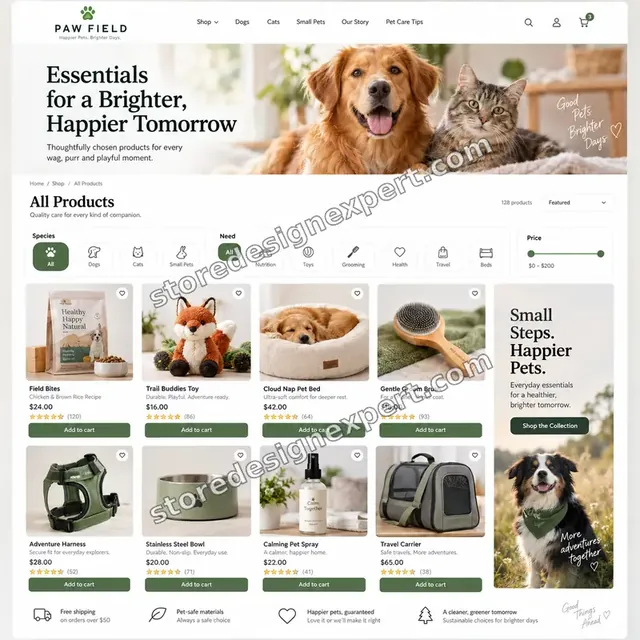
Paw Field Pet Shopify Visual
Pet
Orbit Fine Jewelry Shopify Visual
JewelryProcess and timeline
How We Build Your Skyvia Integration, Step by Step
A fixed order of work keeps the project predictable. You know what happens next at every point.
- 1
Brief and scope
First we find out what you sell, how your team uses Skyvia and which events count. A quick look at your orders and packages tells us where to begin and what to avoid.
- 2
Access and connection
We ask for the smallest access that works, via a read-only connection to the store and a write user on the destination. A live read confirms it before we build on top of it.
- 3
Map and rule
The map covers source, target, mapping and schedule; we put the conflict winners and blank rules in writing.
- 4
Build in a copy
We build against test data, not your live records, and show you the plan and a recorded run where it helps.
- 5
Test on real cases
We run an incremental load, a full refresh and a schema change, then refunds and edits, and verify each outcome against what the store shows.
- 6
Go live and hand over
When you say go, the flow goes live. We watch the first runs and leave you notes, a diagram and a recorded walkthrough.
Compare your options
Which Route Fits: DIY, Platform, Gig or Specialist Build?
There are four common ways to connect Shopify and Skyvia. This table compares the checks that decide whether the data stays right, whether failures are noticed and whether you can hand the link on.
| What matters | Native app or DIY | Zapier, Make or n8n | Marketplace seller | Store Design Expert |
|---|---|---|---|---|
| Careful field-by-field mapping | Defaults | If you build it | Hit and miss | Yes |
| Retries cannot create duplicates | Rarely handled | If you add it | Not usually | Yes |
| A named person hears about failures | No | Only if you add it | Not usually | Yes |
| Edge cases checked: refunds, edits | Seldom | If you test | Depends | Yes |
| You see the cost before we begin | Plan fees only | Plan fees plus your time | Yes | Yes |
| A written and recorded handover | No | No | Not usually | Yes |
| Ownership stays with you | Yes | Yes | Varies | Yes |
| Help after go-live | Vendor support | Platform support | Depends | Included window |
Inside every project
What Keeps Your Store and Skyvia Data Safe
Integrations move customer data between systems, so mistakes are costly. These practices come with every package and explain why a fixed fee can still be a careful one.
A written definition of done
The flow counts as finished only when an incremental load, a full refresh and a schema change all pass and are logged.
Narrow access, in your name
The smallest workable access, set up through a read-only connection to the store and a write user on the destination, with all accounts in your name.
Secrets kept in a vault
A secure vault holds every key and token; none appear in notes or chat.
Build in a copy, never live
We never build on live data: the flow is tested on test records and your real orders and packages wait for your approval.
Counts compared, not assumed
We check totals against the source after each load, so mismatches surface straight away.
Plain scope, two revision rounds
Price first, then two structured revision rounds for anything in scope, so no tweak becomes a surprise charge.
Interactive price calculator
Price Your Shopify Skyvia Integration
Pick a package, answer three short questions and add any extras. Your total and delivery window update as you click, with nothing hidden until checkout.
Request a custom quote
Projects beyond these packages, such as custom objects, heavy history loads, multi-store designs or a custom API build, are scoped and quoted at a fixed price after a short call.
Request a QuoteChanged your mind? Choose Starter Pipeline, Standard Pipeline or Advanced Pipeline above to return to the instant calculator.
Packages and comparison
Skyvia Integration Package Comparison
Here is each package line by line. When you compare our fee with a marketplace listing for Shopify Skyvia integration, count how many of these checks the cheaper offer actually names.
| What is included | Starter Pipeline $690 | Standard Pipeline $1,390Recommended | Advanced Pipeline $2,590 |
|---|---|---|---|
| Skyvia connected using a read-only connection to the store and a write user on the destination | Included | Included | Included |
| Trigger for the event: a schedule runs | Included | Included | Included |
| Field map covering source, target and mapping | Included | Included | Included |
| A unique key on every write | Included | Included | Included |
| Test log and recorded handover | Included | Included | Included |
| Triggers for when a schedule runs, when an order is created and when a schema changes | Not included | Included | Included |
| Mapping extended to schedule and custom fields | Not included | Included | Included |
| Filters by tag, country and value | Not included | Included | Included |
| Failed runs retried, then reported | Not included | Included | Included |
| Both-way sync with a winner for each field | Not included | Not included | Included |
| History load of previous packages | Not included | Not included | Included |
| A fortnight of run checks after launch | Not included | Not included | Included |
| Runbook with the rules and the fixes | Not included | Not included | Included |
| Typical delivery | 3 to 6 days | 6 to 10 days | 10 to 16 days |
The calculator above is the source of truth for your final price and delivery estimate.
Why Store Design Expert
Why Hire Us to Connect Skyvia and Shopify
Most of this job is clicking, and you could do it. People hire us because the unglamorous parts, ids, timing and edge cases, decide whether the connection helps or hurts.
Notes a colleague can follow
Handover notes record the data paths and the choices behind each setting, ready for whoever works on it next.
Experience since 2015
Over 450 Shopify stores since 2015 mean we have seen most of the odd cases that break integrations.
4.9+ from verified clients
The reviews here come from verified clients of Store Design Expert, so you can judge past projects before you pay.
We live inside Shopify
Daily work on orders, refunds and metafields gives us Shopify depth that Skyvia menus alone do not.
A price you can plan around
Every package and option shows its price and extra days in the calculator. Any Skyvia plan fees are billed to you by Skyvia, so check its current pricing page.
Tested on your real cases
Tests use the cases your store really sees, for example an incremental load, a full refresh and a schema change.
What we need to get started
What to Prepare Before We Start Your Skyvia Integration
Three things get the work moving: safe access, a few answers and a decision-maker. Here is the detail.
Approve a collaborator request
Selling already? Send the address and accept a collaborator request. You keep ownership, we get a limited role, and you can revoke it at any moment.
Starting from nothing? We build first
Without a store, we build one in a Partner account with Skyvia connected, then transfer it to you. You pick a plan once everything works.
Or share a staff login
Sharing a staff login is possible. The collaborator route is safer, though: one click removes it and no password is passed around.
Your Skyvia access
Either create the Skyvia account yourself and add us, or we open it with your email. You remain the owner, and we work through a read-only connection to the store and a write user on the destination.
Sample records
Share a few typical records from both tools, or point us to them. Real examples reveal how your data is really structured.
A decision-maker
Tell us who approves the plan and the test, and which rule should win when Skyvia and Shopify disagree.
Your Shopify owner password and card details never reach us. Changes are made in a copy, and we note every setting we touch.
Testimonials
What Store Owners Say After Working With Us
Real owners, real stores, in their own words.
Verified
Store Design Expert is the best. The work is very professional, they pay close attention to detail and, more importantly, they listen. Their level of cooperation is second to none, and everything was delivered in a very timely manner. I will keep them in mind for future projects.
BN
Barbara N.United States
Verified
They kept communicating until the problem was fully resolved, and the result was great.
HJ
Henry J.United States
Verified
Super helpful and patient. I am new to ecommerce and Store Design Expert talked me through the whole process and even fixed my payment bridging for me!
LR
Lois R.United Kingdom
Verified
I am beyond satisfied! Store Design Expert went above and beyond on my project. Highly recommended!
MD
Michael D.United States
Verified
The experience was tailored to my brand and specifications to the letter. I love the result.
EP
Eric P.United States
Verified
They definitely get the job done. Very patient and understanding throughout the whole project.
BS
Brian S.United States
Verified
Thank you so much to Store Design Expert and the team. My site looks far more appealing to customers, and I will happily recommend your services to other new small businesses.
JS
Jennifer S.United States
Verified
Very patient, informative and transparent, and they did exactly what they said they would do. Thanks for all the help!
RO
Raymond O.United States
Verified
Store Design Expert is the only one I use for all things WordPress. They have a high level of understanding, deliver quality work and are easy to deal with.
SC
Scott C.United States
FAQ
Shopify Skyvia Integration FAQs
Answers on cost, timing, access, data and what to do when the connection misbehaves.
How much does Shopify Skyvia integration cost?
Starter Pipeline costs $690, Standard Pipeline $1390 and Advanced Pipeline $2590. Order volume, data direction, existing Skyvia data and add-ons change the total, and the calculator shows it before you pay. Most projects land between about $690 and $3630, with delivery from 3 to 16 working days. This also answers "skyvia shopify workflow".
How long does the Skyvia integration take?
Starter Pipeline takes 3 to 6 working days, Standard Pipeline 6 to 10 and Advanced Pipeline 10 to 16. The usual variables are how much history you want loaded and how quickly you approve the test results. The Sooner and Fastest options shorten the schedule when a launch date is fixed. Another way to phrase it: "hire skyvia shopify expert"; the work is the same.
How do I connect Skyvia to Shopify?
Create a Shopify connection in Skyvia, authorise your store and choose a replication, import or export package. The same job is behind "skyvia shopify integration cost".
Can Skyvia back up my Shopify data?
Skyvia describes scheduled exports to CSV in local or cloud storage, and replication to a database. Neither replaces testing a restore. Queries such as "skyvia shopify workflows" describe the same work. The same service covers "skyvia and shopify automation".
Which databases can Skyvia replicate Shopify to?
Its pages list MySQL, SQL Server, Snowflake, Databricks and BigQuery, among others. If you typed "skyvia shopify expert", the answer is the same. If you came here from "skyvia shopify setup", the answer is the same.
Does Skyvia keep old versions of records?
An optional history mode keeps prior versions, chosen per object. The same job is behind "hire skyvia shopify developer".
Is importing orders and products back into Shopify simple?
Skyvia's blog says nested structures make the mapping complicated, so we test on a small batch. Searches like "how to connect skyvia to shopify" point to this service.
Skyvia or Fivetran?
Both replicate data. We compare cost, connectors and your warehouse. This also answers "skyvia shopify sync".
Can you repair a failing Skyvia package?
Yes. We trace the failure, fix and reconcile. Related searches such as "shopify to skyvia integration", the answer is the same.
Ready when you are
Book Your Shopify Skyvia Integration Build
Choose a package, watch the fixed price settle and order a Shopify Skyvia integration build from a team that has launched 450+ Shopify stores. The connection is tested on real cases before you are asked to approve anything.
- Secure checkout
- Two revision rounds
- Test log and walkthrough included